
Leak Damage Roof Repair in Tucson
Commercial roof leak investigation and repair for Tucson buildings — monsoon-driven infiltration, sand-clogged drains, and UV-compromised seams traced to source and repaired with documented scope.
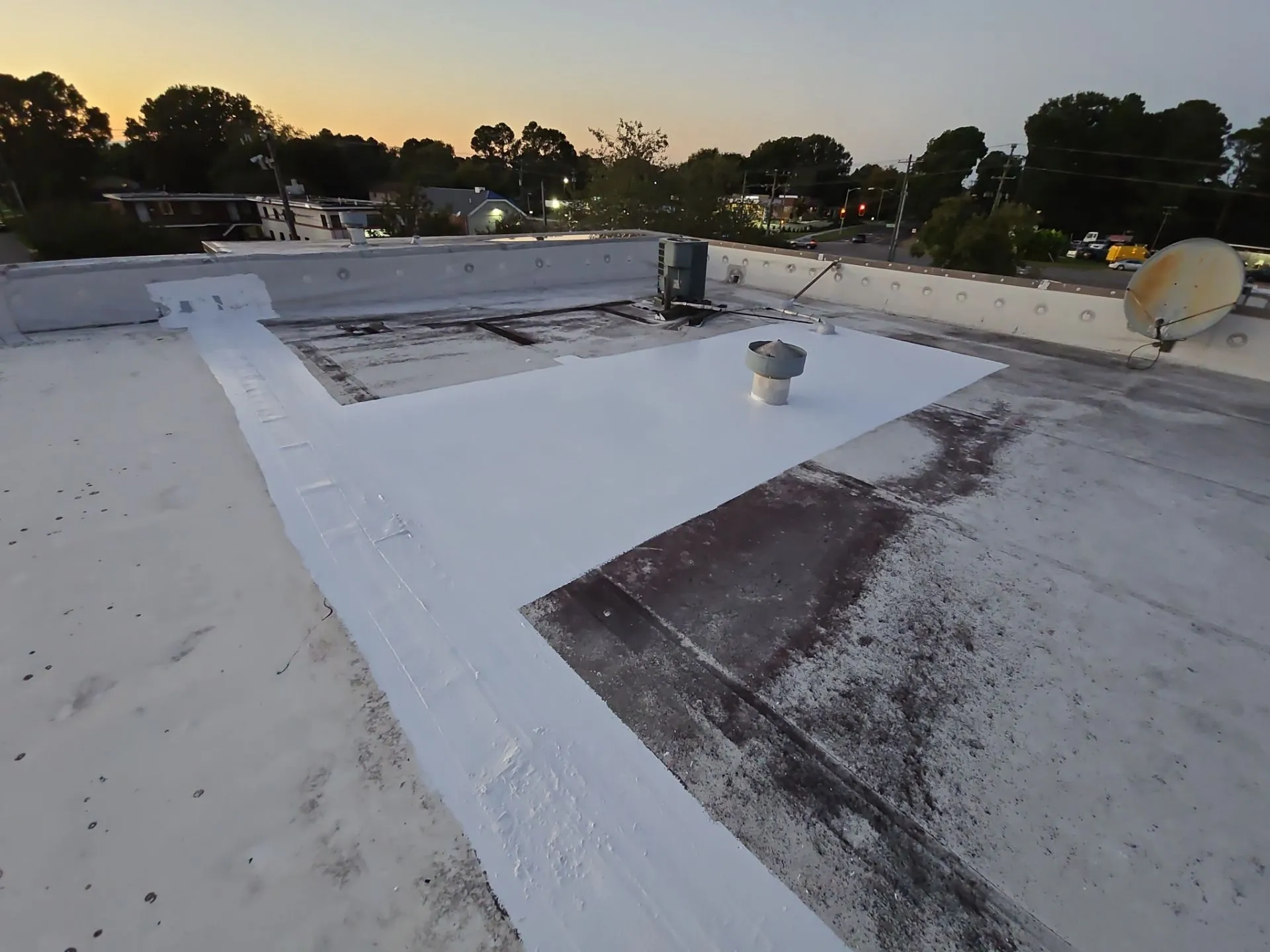
Tucson's monsoon season reveals every seam gap, every blocked drain, and every UV-compromised flashing that spent the dry season looking intact. We trace active leaks to their source on the roof — not just where the ceiling stain shows up — and repair them with documented scope.
Commercial roof leaks in Tucson follow a pattern that is specific to the desert climate cycle. The dry season — roughly October through June — allows seams and flashings to lose adhesion, UV exposure progressively oxidizes lap bonds, and sand and dust pack into drain bowls that have not been serviced since the prior monsoon. The building owner or facility manager has no visible evidence of any problem until the first monsoon event of the season drops an inch of rain in forty minutes. That first event often reveals multiple infiltration points simultaneously, because the roof has spent months accumulating vulnerabilities without any water to reveal them.
The leak that shows up on the interior ceiling is rarely located directly below the infiltration point on the roof surface. Flat-roof water infiltration in Tucson commercial buildings typically enters at a seam gap or a flashing lap at one location, travels laterally along the deck surface or through the insulation for some horizontal distance, and then drops through the deck at the lowest accessible point — which may be 20 to 40 feet from the entry point. Tracing the ceiling stain back to the roof entry point requires systematic elimination rather than a direct vertical projection.
We scope leak repairs by identifying the infiltration pathway, not just patching where the ceiling suggests. That requires a combination of membrane probe testing, infrared scanning, and core pulls at suspected wet-insulation locations. The result is a repair scope that addresses the entry point rather than the symptom — which is the only repair that holds through the next monsoon season.
Tucson's Desert Drain Blockage Mechanism
Tucson receives approximately 12 inches of annual precipitation, of which roughly 60 percent falls during the July-through-September monsoon. The dry months from October through June allow desert dust, wind-blown Sonoran sand, palo verde seed pods, and debris from surrounding desert vegetation to accumulate in roof drain bowls, scupper channels, and overflow drains without any rainfall to flush them. A commercial building with 15 primary drains may have 8 or more partially or fully blocked by late June when the monsoon begins.
A blocked drain on a Tucson commercial roof is not merely inconvenient — it fundamentally changes the water load the roof must manage. When monsoon rainfall cannot drain at the design rate, water depth rises against parapet flashings that were designed to have standing water against them only briefly. Extended standing water backs up against termination bars, enters gaps in perimeter edge metal, and eventually overwhelms lap seams that were not designed for hydrostatic head pressure from 4 or 6 inches of standing water.
We clear and flow-test every primary drain, scupper, and overflow drain as part of our pre-monsoon inspection service. When a post-monsoon leak investigation reveals blocked drains as the primary infiltration cause, we document the blockage separately from any membrane damage — because blocked-drain water intrusion may be treated differently from storm-caused damage by your commercial property adjuster.
UV-Seam Failure as the Primary Tucson Leak Mechanism
The primary source of non-drain-related commercial roof leaks in Tucson is UV-driven seam adhesion loss. TPO and PVC lap seams that were heat-welded at installation maintain their bond through the membrane's early life, but sustained UV Index 11-plus exposure in the Sonoran Desert oxidizes the membrane surface and can eventually affect the lap bond at the seam edges. EPDM adhered seams lose tape adhesion on the same UV-driven timeline. Modified bitumen seams oxidize along the cap sheet surface and eventually develop edge cracks that allow water wicking.
The Tucson-specific pattern is that seam failures accumulate silently during the dry season and then present as multiple simultaneous leaks on the first major monsoon event. A building owner who has not had an active leak in three years may have a dozen seam-edge failures that the dry season has concealed. We probe-test all field seams, lap edges, and T-joints during our annual inspection program — specifically to find UV-compromised seam locations before the monsoon reveals them through ceiling stains.
Parapet flashing laps are the highest-risk seam locations on a Tucson commercial roof because the parapet cap surface receives the most intense UV exposure — vertical surfaces receive direct radiation from low-angle morning and afternoon sun that horizontal membrane surfaces avoid. Parapet flashing inspection is a separate element of our inspection protocol, and parapet flashing lap replacement is a standard repair item on Tucson commercial roofs at the 12-to-15-year mark.
Tracing the Leak Pathway from Ceiling to Roof
Interior ceiling stain location is the starting point for leak tracing, not the ending point. We record ceiling stain locations with building grid coordinates, note the stain pattern (fresh vs. historic, ring-dried vs. active), and identify the deck construction above — metal deck, concrete plank, or wood deck — because each deck type carries water differently before dropping through.
Infrared thermal scanning on a clear Tucson evening — typically 6 to 8 hours after solar heating ends — identifies wet insulation zones through the thermal differential between saturated and dry insulation as the roof radiates stored heat. We scan from the ceiling-stain area outward, following the cooling differential upslope to find the likely infiltration point. Infrared results are cross-referenced with physical core pulls at flagged locations to confirm wet insulation.
The repair scope identifies the infiltration entry point, the horizontal travel pathway through the insulation, and any secondary damage — wet insulation, deck corrosion, ceiling assembly damage — that requires remediation. We do not patch the ceiling stain location alone; we repair the roof entry point and document the full scope of water-affected materials.
Frequently asked questions
We have had the same interior leak location for two monsoon seasons — does that mean the same spot on the roof is leaking?
Not necessarily. Flat-roof water infiltration travels laterally before dropping through the deck, and the path it takes — through the insulation, along the deck surface — tends to be consistent from event to event because the wet pathway is the path of least resistance. The entry point on the roof surface may be 20 or more feet from where the ceiling stain appears. We trace the pathway from the ceiling upward to the roof entry point — which is the location that needs to be repaired.
We cleared the drains last fall and still had leaks this monsoon — what else should we look at?
Drain clearing addresses one of the three primary Tucson commercial roof leak mechanisms. The others are UV-compromised seam adhesion loss and parapet flashing lap failure. If drains are clear and you are still getting monsoon-season leaks, we probe-test the field seams and parapet flashings to find where water is entering. A blocked drain and a UV-compromised seam can both be contributing simultaneously — we look for both.
How long does a leak repair take on a mid-size Tucson commercial building?
A localized seam repair or drain remediation on a building in the 20,000-to-50,000-square-foot range is typically one to two days of repair work after the documentation scope is complete. More extensive repairs — multiple seam zones, parapet flashing replacement across two or more roof faces, wet insulation removal and replacement — take longer and depend on material availability, which we scope out before scheduling. We give you a written scope with a timeline before any repair work begins.
Is our Arizona property insurance likely to cover a roof leak caused by blocked drains?
That depends on your policy language and whether the blockage constitutes a maintenance issue under your policy's coverage provisions — which we are not qualified to advise on. What we can tell you is that we document the drain blockage cause separately from any storm-driven damage when both are present, so your adjuster has a clear record of what was blocked-drain-related and what was storm-caused. Whether and how each is covered is between you, your adjuster, and your carrier.
Active roof leak in a Tucson commercial building?
We trace the infiltration pathway from ceiling stain to roof entry point, identify drain blockage, UV-compromised seams, and flashing lap failures, and repair the source — not the symptom — with a documented scope.
Ready to talk through a roof?
Tell us about the building and the roof problem. We'll document it and put a plan in writing — with an honest repair-vs-replace recommendation and no upsell pressure.
Documented, repair-first commercial & industrial roofing across Tucson and Pima County. Flat and low-slope systems for occupied buildings, planned around your operation.
Services
© 2026 Commercial Roofing Contractors Tucson. All Rights Reserved. Privacy Policy · Terms of Use