
Water Damage Roof Repair in Tucson
Commercial roof water damage remediation for Tucson buildings — monsoon flash-flood penetration, saturated insulation removal, wet deck assessment, and documented repair scope for Arizona property claims.
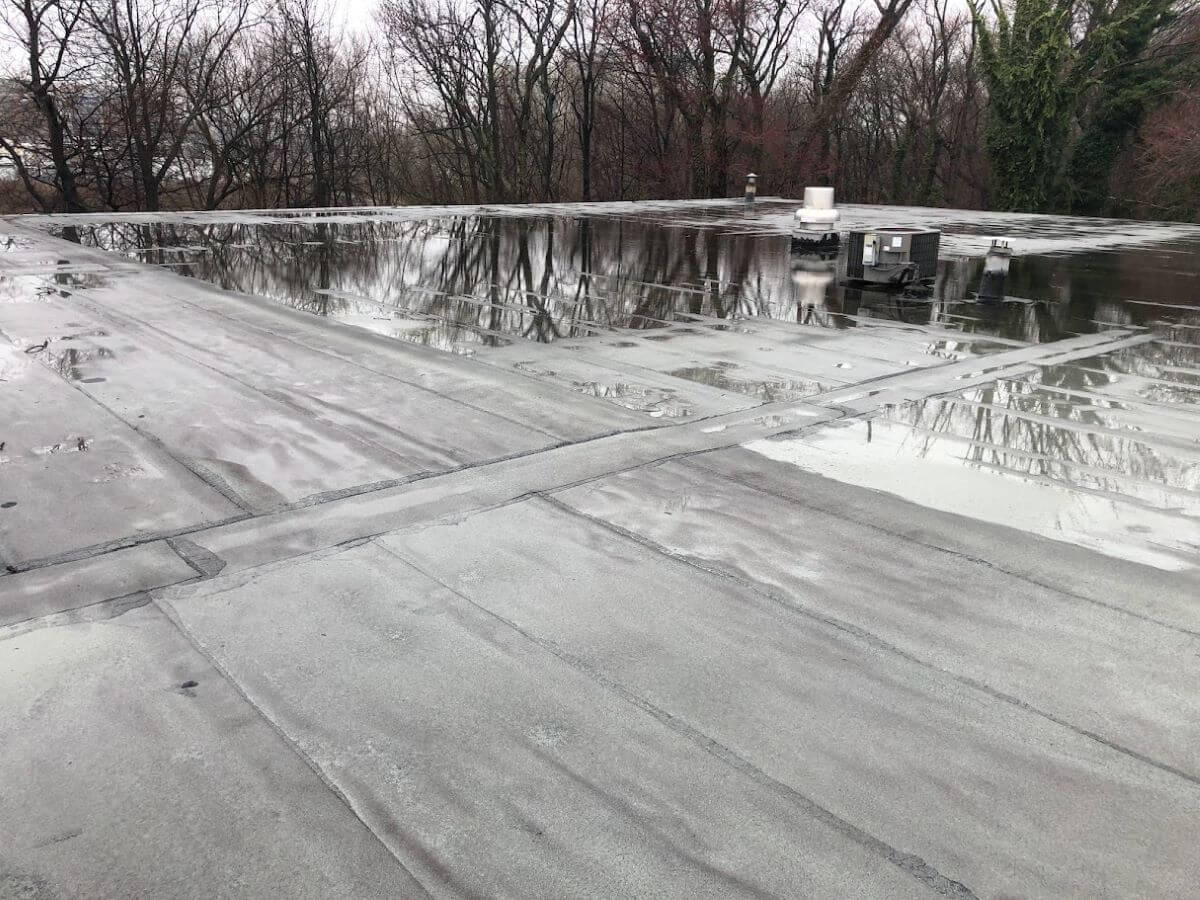
Monsoon flash flooding in Tucson does not just affect ground level. Commercial roofs that are not draining at design capacity under a peak monsoon event accumulate water that compromises insulation, stresses seam bonds, and eventually penetrates the building envelope. We assess the full extent of water damage — from the membrane surface down through the insulation to the deck — and scope the remediation.
Tucson is in a flash-flood-prone geographic setting. The Sonoran Desert's hard caliche soil layer limits water infiltration, and the mountain catchments surrounding the Tucson basin — the Santa Catalinas to the north, the Rincons to the east, the Tucsons to the west, and the Santa Ritas to the south — concentrate monsoon runoff into arroyos that drain through the developed metro. The National Weather Service Tucson office is one of the most active flash-flood warning offices in the country during the monsoon season. When a major monsoon cell stalls over a mountain catchment, the resulting runoff can affect surface drainage around commercial buildings for hours after the precipitation ends.
The roof-level consequence of an intense monsoon event is that drainage systems designed to handle typical rainfall rates — even the elevated rates required by Pima County's design standards — can be overwhelmed by the peak flow rates from a stationary or slow-moving monsoon cell. When roof drainage is overwhelmed or obstructed, water depth accumulates against perimeter flashings, and the waterproofing system's ability to handle hydrostatic head pressure — which was not what it was designed for — determines whether water enters the building.
We assess water damage on Tucson commercial roofs from the membrane surface down through the insulation assembly to the deck. Saturated insulation is the most consequential result of monsoon water accumulation — it continues to deteriorate after the surface water drains, it voids manufacturer warranties, and it creates the deck corrosion pathway that shortens the building's structural life. Documenting what is saturated, removing it, and replacing it correctly is the scope we write.
Moisture Assessment Methods for Tucson Flat Roofs
Infrared thermal scanning is the primary non-destructive tool for mapping wet insulation on a Tucson commercial roof. Clear desert nights — which are the norm in Tucson even during monsoon season, when storm cells are typically convective and clear quickly — provide optimal conditions for post-storm infrared scanning. The thermal differential between wet insulation (which retains heat as it re-radiates stored solar energy) and dry insulation is detectable for 6 to 8 hours after solar heating ends. We scan from a safe vantage after the storm clears and produce a GPS-referenced wet-zone map.
Core pulls at flagged infrared locations confirm insulation saturation and document the saturation level — surface-wet versus fully saturated versus insulation facer damaged but dry below. Core results are photographed and logged against the zone diagram. On a 40,000-square-foot commercial roof, a typical post-monsoon-flood moisture investigation involves 4 to 8 infrared-guided core pulls to map the full extent of saturation.
Deck condition below saturated insulation is assessed at core pull locations. Metal deck that has been in contact with standing water for extended periods — particularly during a period when the building's drainage was blocked — may show surface rust at the deck ribs below the core pull. We photograph and log any visible deck corrosion and note its location on the zone diagram. Significant deck corrosion changes the insulation replacement scope from a surface repair to a deck inspection and potential deck repair that requires structural engineering review.
Saturated Insulation Removal and Replacement
Wet insulation on a Tucson commercial roof does not dry out under the membrane — the membrane prevents the evaporation that would allow drying. Polyiso insulation in contact with monsoon-season water at 105°F ambient temperatures does not dry; it deteriorates. The organic facer material on standard-density polyiso boards is particularly susceptible to wet-rot degradation at Tucson summer temperatures. There is no rehabilitation scope for saturated polyiso — it must be removed and replaced.
Replacement insulation on a Tucson commercial building is specified with the same criteria we use for new installation: high-density polyiso or a polyiso-plus-cover-board stack to address thermal drift at 175°F surface temperatures, and reflectivity-compliant top surface for IECC 2018 energy code compliance. We do not replace saturated insulation with the same specification that saturated — particularly if the saturation event revealed a drainage deficiency that is also being remediated.
Monsoon-season saturated-insulation replacement requires attention to the dry-in protocol. July-through-September repair work must be sequenced so that exposed deck areas are dried in before crew departure, regardless of afternoon forecast. We apply the same monsoon dry-in discipline to repair projects that we apply to full replacement projects.
Drain System Remediation and Overflow Capacity
Post-flood water damage on a Tucson commercial roof almost always involves a drainage deficiency — either blocked primary drains, inadequate overflow drain capacity, or ponding areas where drain elevation has shifted relative to the surrounding membrane from thermal cycling or structural movement. Removing saturated insulation without remediating the drainage deficiency means the replacement insulation will be saturated in the next major monsoon event.
Overflow drain capacity is a specific code requirement under the International Plumbing Code as adopted by the City of Tucson and Pima County. The overflow drain system — scuppers, overflow drains, or a combination — must be capable of handling the 100-year storm event independently of the primary drain system, which is designed for the more frequent 10-year event. Many commercial buildings in the Tucson market were built with overflow scuppers that are set too high or too small to perform this function. We assess overflow capacity and document it in the repair scope when drainage deficiency is part of the water damage cause.
Pima County Regional Flood Control District publishes storm frequency data for the Tucson metro that we use in drain-capacity assessments. When a water damage investigation reveals that the drainage system is undersized for the design storm, we scope the drainage upgrade alongside the insulation replacement — because the combination is what prevents recurrence.
Frequently asked questions
We had standing water on our Tucson commercial roof for 24 hours after a monsoon event — how bad is the insulation damage likely to be?
Twenty-four hours of standing water at Tucson summer temperatures — 105°F ambient, membrane surface potentially still above 120°F in the afternoon — produces rapid polyiso insulation deterioration at the contact zone. The infrared scan after the event will show the wet zone extent, and core pulls will confirm the saturation depth and facer condition. In our experience with post-monsoon flooding on Tucson commercial roofs, 24-hour inundation at those temperatures produces fully saturated insulation across the flooded zone that requires removal and replacement.
Will our Arizona property insurance cover saturated insulation replacement after a monsoon flood?
That depends on your policy language and how the event is characterized — storm-caused versus drainage-maintenance-related. We document the cause separately from the damage: what was the drainage condition, was the blockage pre-existing or storm-caused, was the overflow system functioning. That documentation gives your adjuster a clear picture of the cause, which affects how the claim is attributed. Coverage determination is between you, your adjuster, and your carrier.
How do you handle infrared scanning on a monsoon-cloudy night?
Monsoon nights in Tucson are often clear — the convective cells that produce the rain clear rapidly after the storm, and the Sonoran Desert sky clears within hours. If the night after a major event is overcast, we typically wait one day for the thermal differential to re-establish after another heating cycle. Overcast infrared scanning produces lower-contrast results that can miss moderate saturation. We scan when the thermal conditions are right rather than rushing a low-quality result.
Can you assess deck corrosion below the saturated insulation?
Yes. Core pulls at infrared-flagged locations expose the deck surface below the insulation. We photograph any visible corrosion, measure affected area, and note it in the scope report. Significant deck corrosion — surface rust that has pitted or reduced the deck thickness — requires structural engineering review before the deck scope is finalized. We do not spec structural deck repairs in isolation from engineering clearance.
Monsoon water damage investigation for a Tucson commercial roof?
We scan for wet insulation using infrared, pull cores to confirm saturation depth, assess deck condition below, and scope the removal and replacement — with drainage remediation included when blocked or undersized drains are part of the cause.
Ready to talk through a roof?
Tell us about the building and the roof problem. We'll document it and put a plan in writing — with an honest repair-vs-replace recommendation and no upsell pressure.
Documented, repair-first commercial & industrial roofing across Tucson and Pima County. Flat and low-slope systems for occupied buildings, planned around your operation.
Services
© 2026 Commercial Roofing Contractors Tucson. All Rights Reserved. Privacy Policy · Terms of Use