
Commercial Roof Capital Planning in Tucson
Multi-year roof CapEx forecasting for Tucson commercial property owners — condition-data-driven sequencing, Sonoran Desert-calibrated lifecycle analysis, and written capital documents for budget approval at institutional and private ownership levels.
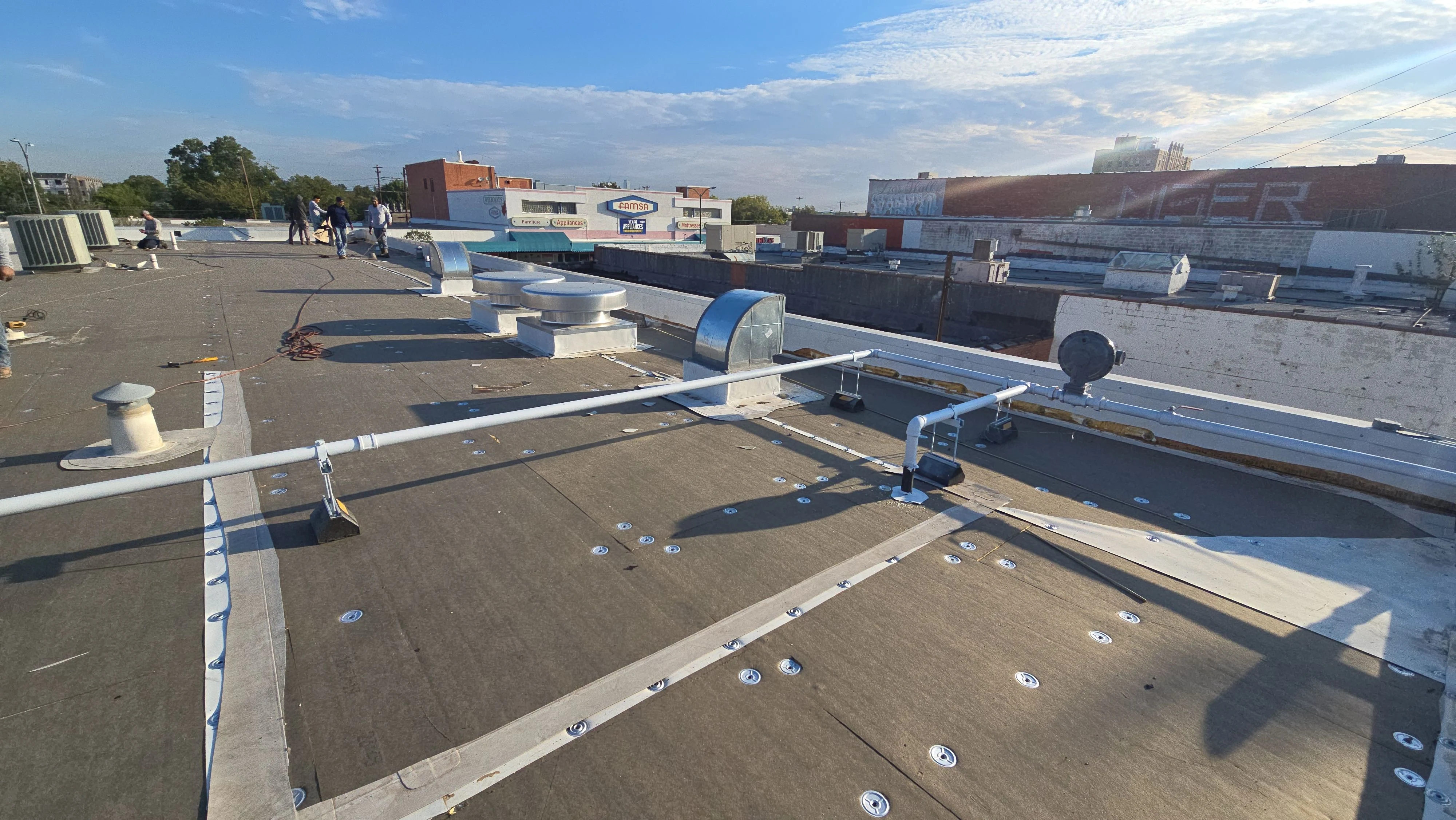
Roofing CapEx across a Tucson commercial portfolio is predictable when you have condition data built on the actual Sonoran Desert degradation curve — not manufacturer lifecycle tables calibrated for northern climates. We build the multi-year capital plan, sequence replacements against your budget, and produce documentation that holds up in a capital committee review.
Capital requests for commercial roof replacement fail for two reasons: the data behind the ask is weak, or the request is reactive — filed after the roof fails, without the planning horizon that lets finance build around it. Both failures cost money. Emergency replacement under reactive-mode conditions runs 15 to 25 percent above planned-work cost. A capital ask without defensible condition data gets deferred, which turns a manageable replacement into an emergency when the next monsoon season finds a roof in condition 2.
Our capital planning work starts with condition data and ends with a written document that a facilities director or asset manager can submit to an ownership group, a capital committee, or a government budget process. It includes per-building replacement cost bands priced against current Tucson roofing material and labor costs, a five-year sequencing plan, and a lifecycle cost analysis that accounts for what the Sonoran Desert does to membrane degradation timelines.
Tucson's institutional accounts operate on distinct budget cycles that private portfolio owners do not. The University of Arizona fiscal year and capital planning process has its own submission windows and documentation requirements. Pima County's budget cycle requires capital requests supported by documented condition assessments and cost estimates in a specific format. DMAFB contractor coordination programs have federal procurement requirements that affect how capital documentation is structured. Private commercial portfolio owners have their own ownership-group approval processes. The capital planning deliverable is the same fundamental document — condition data, cost bands, sequencing, lifecycle analysis — formatted for the relevant audience.
Building the Five-Year CapEx Forecast
The forecast starts with the current condition record for every building. Buildings rated condition 1-2 are in the immediate replacement queue — year one or year two. Buildings rated condition 3 are in the monitoring queue — years three through five, with a replacement trigger defined by specific conditions that would move them forward. In Tucson, condition-3 buildings need to carry a closer watch than the same rating in a moderate climate because the acceleration to condition 2 can happen within a single monsoon season on a UV-stressed membrane.
Cost banding: We produce cost bands rather than precise replacement cost numbers for years three through five because material costs move over that horizon. Current Tucson market rates for planned commercial TPO replacement on a mid-size building are documented specifically for each building based on its roof area, access conditions, insulation specification, and rooftop equipment. We note that the energy code's reflectivity compliance requirement for Climate Zone 2 is priced into every specification — white TPO or PVC is not optional under Arizona IECC 2018, and the cost band reflects that constraint.
Sequencing: We recommend sequencing based on condition urgency, UV-degradation rate, monsoon season risk, and business impact. For Tucson accounts, monsoon season risk is a sequencing variable that is not relevant in most other markets — a building in condition 3 with compromised drain infrastructure is a higher-priority replacement than a building in the same condition rating with sound drainage, because the monsoon season's consequences are asymmetric. Blocked drains plus condition-3 membrane plus an active monsoon season is a building-damage event. Sound drains plus condition-3 membrane buys another inspection cycle.
Defending the Capital Ask
The written capital document is formatted for a capital committee or budget-authority review. It includes: the condition summary for each building in the ask, with zone diagrams, condition ratings, and photo documentation of the conditions driving the rating; the cost band for the replacement scope; the lifecycle cost analysis showing replace-now versus deferred cost including the premium for emergency-mode replacement and ongoing repair cost; and the sequencing rationale.
For Tucson institutional accounts with public budget processes — Pima County facilities, Pima Community College, or UA capital programs — the document needs to meet public-process documentation standards. We have produced capital documents that support Pima County's asset management submissions, University of Arizona deferred maintenance budget requests, and Banner Health campus capital planning processes. The format adjusts to the audience; the condition data underneath it is the same.
Lifecycle Cost Analysis — Tucson-Calibrated
The lifecycle cost analysis for a Tucson commercial roof compares replace-now at planned cost, defer with ongoing repair cost and increased replacement premium, and recover (silicone coating or single-ply recover) to extend service life where the substrate supports it. Each scenario is costed against the building's actual condition data and the Tucson-specific degradation rate.
The coating option is more relevant in Tucson than in most other markets. A silicone restoration coating on a sound substrate with dry insulation can extend service life 10 to 15 years at roughly one-third the cost of tear-off and replacement. That is a significant capital deferral option when it is available. But the coating option is only valid when core sampling confirms the insulation is dry — coating over wet insulation voids the new coating warranty and accelerates deck deterioration under the Tucson heat cycle. The lifecycle analysis documents the core-sampling finding and whether the coating option is in or out of the scenario set for each building.
Frequently asked questions
How far out should a Tucson asset owner be planning roof capital?
Five years is the minimum useful horizon. Given the Sonoran Desert's accelerated degradation cycle, buildings in the condition-3 range need to be in a five-year plan with annual condition updates — they can move to condition 2 faster here than manufacturer lifecycle tables suggest. The capital plan should be updated annually after the post-monsoon inspection cycle so that each October's findings narrow the forecast for the following budget year.
What do you need from us to build a capital plan?
The building list with approximate roof area and age, any prior inspection reports or warranty documents available, and access for a baseline inspection of each building. If we are already running the portfolio's inspection program, the capital plan is built directly from the existing condition record without additional site visits. For institutional accounts with specific budget-submission formats, we need those format requirements before we draft the document.
Can you support a capital request for a public entity like Pima County or a school district?
Yes. Public-entity capital requests require documentation that meets public-process standards — condition data with supporting photographs, cost estimates in a format compatible with competitive-bid procurement, and lifecycle cost analysis that can be defended in a public meeting. We have produced capital documents for Pima County submissions and institutional accounts that operate under public procurement requirements. The documentation format adjusts; the underlying condition data and cost analysis are the same.
Does a silicone coating extend the capital horizon enough to matter?
On the right building, yes — 10 to 15 years of additional service life at roughly one-third of replacement cost is a significant capital deferral. The critical condition is dry insulation, confirmed by core sampling. If the insulation is wet or significantly damp, coating is not a viable option — it is not a capital decision, it is a replacement decision. We document the core results in the lifecycle analysis so the owner can see which buildings are coating candidates and which are not.
Build a defensible capital plan for your Tucson roof portfolio.
We produce the five-year forecast, the sequencing recommendation, and the written capital document your ownership group or budget authority needs to approve the ask. Call 520-523-6122 or use the form.
Ready to talk through a roof?
Tell us about the building and the roof problem. We'll document it and put a plan in writing — with an honest repair-vs-replace recommendation and no upsell pressure.
Documented, repair-first commercial & industrial roofing across Tucson and Pima County. Flat and low-slope systems for occupied buildings, planned around your operation.
Services
© 2026 Commercial Roofing Contractors Tucson. All Rights Reserved. Privacy Policy · Terms of Use