
Commercial Roofing in Downtown Tucson
Commercial roof inspections, replacements, and maintenance for Downtown Tucson buildings — Tucson Convention Center, Pima County Courthouse complex, Old Pueblo office towers, and Congress Street mixed-use.
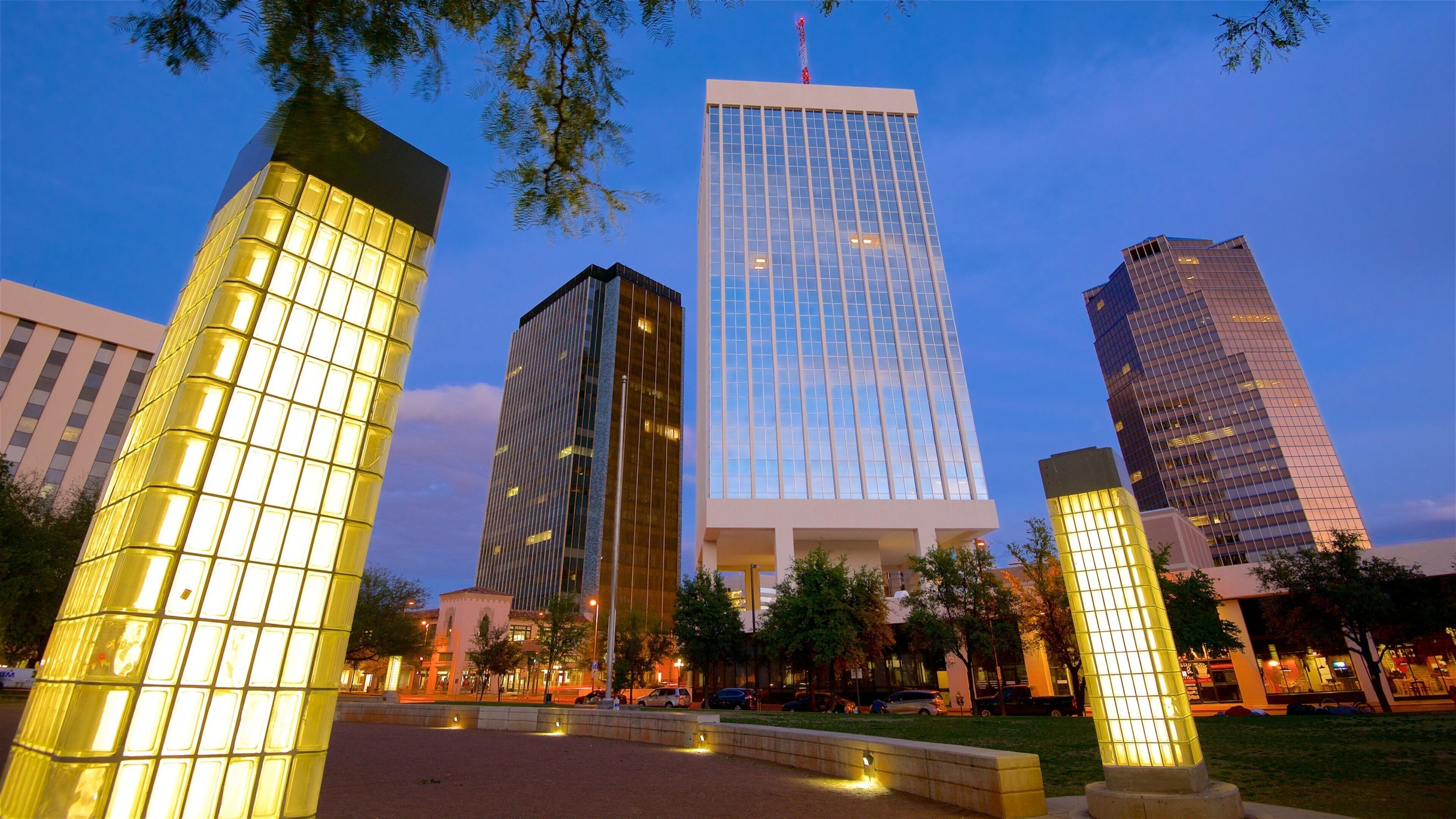
Downtown Tucson anchors on the Tucson Convention Center, the Pima County Courthouse complex, and the Old Pueblo's concentrated office and government building inventory — most of it 1960s through 1990s construction on flat-roof systems that have cycled through decades of Sonoran UV, monsoon events, and thermal stress.
The Downtown Tucson commercial inventory runs from the Tucson Convention Center on South Granada Avenue east through the Pima County Courthouse block on West Congress Street and north into the government and office towers along Church Avenue and Stone Avenue. Most of this building stock was constructed between 1960 and 1995 — old enough that many buildings are on their second or third major roof system. What decades of UV and monsoon exposure do to a flat roof in this climate is not subtle: oxidized membranes, failed parapet flashings, and saturated insulation cores at drain pans are the dominant failure patterns in this inventory.
The Tucson Convention Center itself covers more than 200,000 square feet of meeting hall, arena, and exhibition space. Municipal and county government buildings — the Pima County Courthouse, the Pima County Administration Building, and multiple City of Tucson facilities — require permit coordination with their respective facilities departments and often involve prevailing-wage documentation. Private office towers along Church Avenue and the older Congress Street retail corridor have their own mix of property management requirements. We work in all of these building types and have the permit and documentation experience that downtown institutional and government work demands.
Downtown Tucson's urban geometry creates site access conditions that suburban commercial work does not have. Street parking restrictions, crane set-up coordination with the City of Tucson Transportation Department, and pedestrian-protection measures on active sidewalks are standard elements of every downtown project we scope. We identify access constraints in the pre-construction phase and build them into the project timeline before contract execution.
Tucson Convention Center and Government Campus Roofing
The Tucson Convention Center occupies multiple connected structures on South Granada Avenue — the arena, the convention hall, the Leo Rich Theater, and support buildings. Rooftop mechanical systems serving a venue of this scale are dense: HVAC equipment, exhaust fans, drainage sumps, and utility penetrations are concentrated at curbed areas that require precise flashing integration. Replacement work on large assembly venues requires scheduling coordination around booked events; a 200,000-square-foot roof does not get replaced in a single mobilization, and each section must be sequenced around the Convention Center's event calendar.
Pima County government buildings in the courthouse block operate on standard government procurement requirements. Prevailing-wage certification, certified payroll documentation, and bonding at levels above standard commercial projects are typically required. We carry the bonding capacity and documentation systems for government-scale commercial roofing work in Pima County. Permit coordination runs through both the City of Tucson Development Services Center and Pima County Facilities Management depending on building ownership.
Old Pueblo office and commercial buildings along Congress Street and Broadway Boulevard — many of them historically significant or in the Barrio Viejo and El Presidio historic districts — require care with penetration work and parapet modification. The City of Tucson Historic Preservation Office reviews exterior modifications to buildings in designated historic districts. We identify historic-district status in our pre-construction assessment and coordinate with the preservation office as required before permit submittal.
Urban Site Access and Scheduling
Material staging in Downtown Tucson is constrained in ways that suburban commercial work is not. Loading from Church Avenue, Granada Avenue, or Congress Street requires temporary lane closures coordinated through the City of Tucson Transportation Department's right-of-way permit process. We obtain right-of-way permits as part of every downtown project and coordinate staging windows with the project owner and city permit office. Large-format material deliveries — TPO rolls, insulation board pallets — are typically staged overnight or in early-morning windows to minimize traffic impact.
Crane and aerial-lift access requires survey of overhead utility lines along all four sides of downtown buildings. The downtown grid has active power, telecom, and streetcar infrastructure that must be de-energized or flagged during crane operations. We engage Tucson Electric Power and Cox/CenturyLink utility coordinators early in the planning process for any downtown project requiring overhead crane work.
Pedestrian protection measures on active downtown sidewalks — debris netting, overhead catch platforms, and temporary walkway enclosures — are standard requirements under City of Tucson construction codes. We design pedestrian protection as part of the project plan and document it in the safety plan submitted with the permit package. Downtown pedestrian activity in the Congress Street corridor and near the Pima County Courthouse complex is consistent enough that protection measures remain in place for the full project duration.
Downtown Tucson Roof Inventory Conditions
The 1960s through 1980s downtown building stock predominantly carries built-up roofing or early modified-bitumen systems that were either never replaced or received a single-ply overlay in the 1990s or early 2000s. Where a single-ply overlay was installed over the original BUR without removing saturated sections, we find layered insulation profiles with trapped moisture that the decades of UV-heated thermal cycling have driven deep into the stack. Core pulls at drain pans and parapet corners on these buildings routinely show moisture content above 30 percent.
The 1990s office towers along Church Avenue and Stone Avenue are mostly on first-generation 45-mil TPO systems approaching or past 25 years of service in the Sonoran Desert UV environment. At this age, seam probe tests on these roofs find lap failures that are not yet causing interior leaks but are within one monsoon season of doing so. Annual seam inspection is the only way to catch these failures before they become emergency calls.
Reflectivity compliance is a consistent issue on downtown buildings where owners have deferred replacement on dark-surface modified bitumen systems. Arizona IECC 2018 mandates minimum solar reflectance on new commercial roofs in Climate Zone 2 — when a downtown building finally triggers a replacement scope, the energy-compliance documentation becomes part of the permit package and the insulation and membrane specification have to
Frequently asked questions
Can you handle prevailing-wage requirements for Pima County government building roofing?
Yes. Government building roofing in downtown Tucson frequently requires prevailing-wage certification under Arizona's state and county procurement rules. We maintain certified payroll documentation systems and carry bonding at levels appropriate for public facilities projects. Prevailing-wage project requirements are identified during the pre-construction assessment and built into the contract before execution.
How do you manage crane and material staging on narrow downtown Tucson streets?
We coordinate right-of-way permits through the City of Tucson Transportation Department for any staging or crane work that affects the public right-of-way. Staging windows are typically overnight or early-morning hours to minimize traffic disruption. Crane set-up requires utility coordination with Tucson Electric Power for overhead line clearances — we initiate that process six to eight weeks before the crane mobilization date.
Does the Old Pueblo's historic district status affect roofing permits?
For buildings in designated historic districts — Barrio Viejo, El Presidio, and portions of the downtown commercial district — exterior modifications including parapet work and visible edge-metal changes require review by the City of Tucson Historic Preservation Office before permit issuance. We identify historic-district applicability in the pre-construction assessment and account for the additional review timeline in the project schedule.
What membrane system is specified for downtown Tucson flat roofs?
White or light-gray TPO or PVC mechanically attached over tapered polyiso insulation is the standard specification for downtown Tucson commercial flat roofs. Reflectivity compliance with Arizona IECC 2018 is documented in the permit package. Silicone coating over sound existing membranes is evaluated before recommending tear-off — moisture cores determine whether coating is a viable capital option for buildings with intact but aging membranes.
Schedule a downtown Tucson commercial roof assessment.
Our project managers run regular inspection routes through the Convention Center district, courthouse block, and Church Avenue corridor. We produce written condition reports with permit coordination, moisture-core documentation, and a capital scope appropriate for government, institutional, or private downtown buildings.
Ready to talk through a roof?
Tell us about the building and the roof problem. We'll document it and put a plan in writing — with an honest repair-vs-replace recommendation and no upsell pressure.
Documented, repair-first commercial & industrial roofing across Tucson and Pima County. Flat and low-slope systems for occupied buildings, planned around your operation.
Services
© 2026 Commercial Roofing Contractors Tucson. All Rights Reserved. Privacy Policy · Terms of Use