
Commercial Roof Coatings in Tucson, AZ
Fluid-applied silicone roof coatings for Tucson commercial buildings — reflectivity-restoring systems on UV-degraded membranes, moisture-core qualification before every project, and 10-to-20-year warranty paths at roughly one-third the cost of replacement.
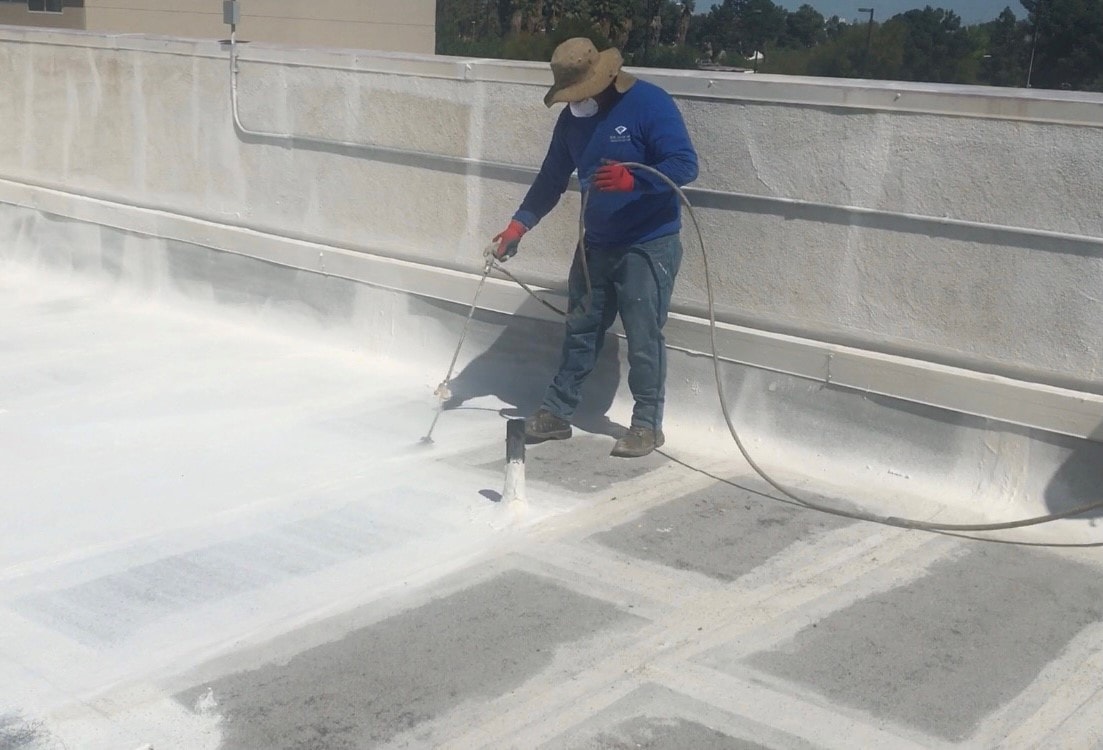
Silicone fluid-applied coatings on qualifying Tucson flat roofs — reflectivity restored on UV-oxidized membranes, 10-to-20-year manufacturer warranty paths, and an honest assessment of whether your roof's substrate can support the system before any coating is specified.
Silicone coating is the most commonly appropriate life-extension strategy for Tucson commercial flat roofs — and the most commonly misapplied one. The Sonoran Desert case for coating is genuinely strong: a white silicone topcoat restores the solar reflectance that UV oxidation has stripped from an aging TPO or single-ply membrane, reducing rooftop surface temperatures by 40 to 60 degrees Fahrenheit on a surface that may have drifted toward dark gray. That reflectance restoration alone extends the remaining life of the underlying membrane by reducing thermal cycling stress. On a roof with dry insulation and an intact substrate, a properly specified 20-mil to 30-mil silicone system carries a 10 to 20-year manufacturer warranty at roughly 30 to 40 percent of tear-off-and-replacement cost.
The problem is that Tucson's monsoon cycle creates saturation patterns that surface inspection cannot detect. An aging membrane that has been baking under UV Index 11 for five months develops micro-cracking at seams and laps that lets early-season monsoon water under the membrane before it shows on the interior ceiling. The heat cycle that follows drives that absorbed water deeper into the insulation stack rather than evaporating it upward. Coating over saturated insulation traps that moisture, voids the new coating warranty in the first season, and accelerates the deck corrosion that ultimately forces a full replacement at higher cost. We pull moisture cores before every coating project. No exceptions.
We install silicone coatings, silicone-over-SPF hybrid systems, and acrylic coatings on qualifying Tucson commercial roofs. If a roof does not pass the qualification criteria — dry insulation confirmed by cores, serviceable membrane, no systemic seam failure — we tell you plainly and explain what honest alternative applies. Our coating business depends on systems that perform through warranty term, not on selling the project.
Silicone Coating Specifications for Tucson Climate
Base coat and topcoat system: Standard 20-year warranty silicone systems in the Tucson market require a minimum of 30 mils dry film thickness (DFT) total — typically a 20-mil base coat and a 10-mil topcoat. Tucson's UV load accelerates surface erosion of the coating layer, which means under-spec'd applications fail to maintain reflectance within three to five years. Warranty mil thickness is verified by the manufacturer's field representative at the time of application or inspection. We do not cut mil thickness to reduce product cost on any project.
Surface preparation under Tucson conditions: Tucson's airborne dust — caliche particulate, desert silt, HVAC condensate residue, and debris from haboob events — accumulates on membrane surfaces and reduces coating adhesion if not fully removed before application. We pressure-wash at 3,000 to 4,000 psi, allow complete drying (Tucson's dry air accelerates this), spot-prime failed seams and flashing edges with compatible primer, and re-flash any penetration boots or parapet flashings that show cracking before coating begins. Re-flashing before coating is not optional — a degraded flashing under a coating system fails through to the interior in two to three seasons.
SPF/silicone hybrid for insulation upgrade and ponding correction: Spray polyurethane foam applied at one to three inches adds R-6 to R-7 per inch — which is critical on Tucson roofs where standard-density polyiso has already lost effective R-value from sustained thermal drift at 175-degree surface temperatures. SPF also corrects ponding areas by building up low spots before the silicone topcoat is applied. Tucson medical-office and research buildings near the University of Arizona have used this hybrid specifically for the dual benefit of insulation compliance and life extension.
When Coating Is the Right Call in Tucson — and When It Is Not
Coating makes sense for a Tucson commercial roof when: moisture cores confirm dry insulation across the full membrane field, seams are probe-intact or can be repaired at cost-effective scope before coating, the building owner's capital horizon aligns with a 15 to 20-year performance window rather than a full replacement, and the aging membrane has darkened sufficiently from UV oxidation that reflectance restoration is a material energy-compliance benefit. The most common qualifying profile we see in Tucson is a 12-to-18-year-old white TPO or single-ply roof on a midtown professional or medical-office building that has stayed dry but lost its reflective finish.
Coating is the wrong call when: core pulls show saturation in more than 20 to 25 percent of the roof area — the threshold is tighter in Tucson than in moderate climates because the heat cycle that follows coating application will drive trapped moisture into accelerated deck corrosion; systemic seam failure runs across the full field membrane rather than in isolated zones; or structural ponding exists that the coating system cannot address and that SPF fill cannot correct at reasonable cost. We see coating proposals on Tucson roofs that have failed this qualification — usually because the contractor involved cannot get a replacement contract with the owner's current capital budget. We do not operate that way.
Manufacturer Warranty Paths Available in Tucson
10-year NDL coatings: Available from GS Roofing, Tremco, and Conklin on 20-mil total DFT applications. Appropriate for Tucson roofs in the eight to twelve year remaining-life range where the owner wants warranty protection at minimum capital outlay.
15-year NDL coatings: Requires 25 to 30 mil total DFT from qualified applicators. Available from Tremco and Henry on qualifying systems. Most common selection for Tucson buildings in the 10 to 15-year remaining-life range where the capital case for full replacement is not yet compelling.
20-year NDL coatings: Requires 30-plus mil total DFT and a manufacturer-representative inspection at application. Available from Tremco, Henry, and Conklin on qualifying systems with full surface preparation and re-flashing documentation. The long-term capital play that produces the lowest 20-year lifecycle cost on buildings with dry insulation and intact substrates.
Frequently asked questions
Can a silicone coating be applied over an existing TPO membrane in Tucson?
Yes, on roofs that pass the qualification criteria: dry insulation confirmed by cores, serviceable membrane with no systemic seam failure, and a clean bondable surface. TPO surfaces in Tucson typically show UV chalking that must be fully removed by pressure washing and light abrasion before primer and coating adhesion are reliable. Generic silicone over un-prepped UV-oxidized TPO delaminates in two to three Tucson seasons. We do not skip surface preparation steps.
How does Tucson's summer heat affect coating application scheduling?
We apply silicone coatings in the early morning window — typically 5:30 AM to 11:00 AM — before rooftop surface temperatures exceed 120 to 130 degrees. At 160-to-175-degree surface temps, silicone cure rates are too rapid for consistent mil-thickness application and adhesion quality drops. Tucson summer coating projects run on compressed daily schedules: surface prep in the late afternoon of the prior day, coating application at first light. Monsoon season (July through September) adds an afternoon-storm risk window that limits full-day production during July and August.
Does coating the roof count as maintenance under my existing manufacturer warranty?
This depends entirely on the existing warranty's terms. Some manufacturer warranties explicitly void upon application of any non-approved coating product. Others allow silicone coating as a compliant life-extension measure when the coating product comes from an approved manufacturer and the application is documented per the warranty protocol. We review your existing warranty document before specifying any coating product to avoid inadvertent conflicts. In Tucson, we find this issue most often on Carlisle and Johns Manville NDL warranties — each has specific language that matters.
Is your Tucson commercial roof a coating candidate?
We will walk the roof, pull moisture cores, and give you a written assessment — qualifying criteria met or not, with the core data and the reasoning behind the recommendation. No coating is specified on a roof that cannot support it.
Ready to talk through a roof?
Tell us about the building and the roof problem. We'll document it and put a plan in writing — with an honest repair-vs-replace recommendation and no upsell pressure.
Documented, repair-first commercial & industrial roofing across Tucson and Pima County. Flat and low-slope systems for occupied buildings, planned around your operation.
Services
© 2026 Commercial Roofing Contractors Tucson. All Rights Reserved. Privacy Policy · Terms of Use