
Commercial Roofing in the DMAFB Area
Commercial roofing for Davis-Monthan AFB peripheral commercial zones — Alvernon Way, Kolb Road, and Irvington Road defense-contractor and industrial buildings supporting southeast Tucson base operations.
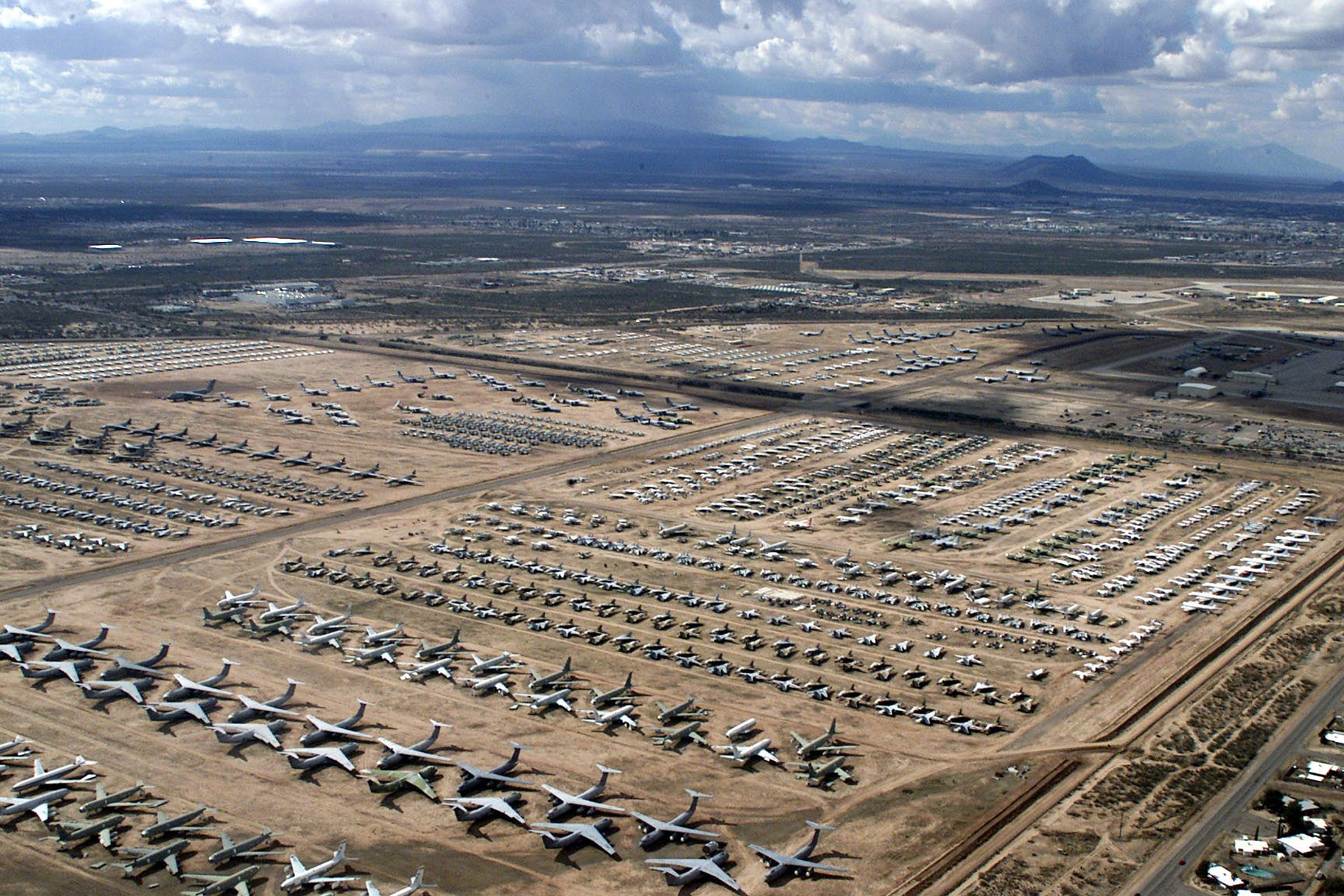
Davis-Monthan Air Force Base occupies roughly 6,000 acres on Tucson's southeast side — and the commercial corridors along Alvernon Way, Kolb Road, and Irvington Road that wrap its perimeter house the defense-contractor, logistics, and industrial buildings that support base operations and the broader southeast Tucson employment base.
Davis-Monthan AFB is one of the busiest tactical air bases in the United States and the home of the 309th Aerospace Maintenance and Regeneration Group — the AMARG boneyard — which maintains the world's largest inventory of stored military aircraft. The base employs approximately 6,800 military and civilian personnel and supports a substantial contractor workforce. The commercial buildings that serve this base — contractor offices, logistics facilities, technical support operations, and manufacturing spaces — are concentrated in the Alvernon Way, Kolb Road, and Irvington Road corridors that run along the base's east, north, and west perimeters.
Base contractor work at Davis-Monthan requires DD Form 254 security clearance documentation for contractor personnel accessing controlled base areas. Commercial roofing work on buildings outside the controlled perimeter — in the surrounding contractor and industrial corridors — does not require the DD 254 but does frequently involve employers with security-sensitive operations whose employees have access badge requirements for the adjacent base. We are familiar with the coordination protocols for working adjacent to and in support of active military installation operations.
The southeast Tucson commercial corridors adjacent to DMAFB also serve the broader residential and commercial base in the Midvale Park, Cragin, and Rita Ranch areas. Big-box retail on South Kolb Road, medical and professional offices along East 22nd Street, and the light-industrial inventory on East Irvington Road represent commercial real estate that serves residential as much as defense-sector demand. The roof conditions in this inventory follow the standard Sonoran Desert aging pattern — membrane oxidation, seam fatigue, and drain-area saturation accumulated over 30 to 40 years of heat and monsoon cycling.
Defense-Contractor and Industrial Building Inventory
The industrial and contractor-support buildings along Alvernon Way south of 22nd Street and Kolb Road north and south of Golf Links Road were developed in two primary waves: late 1970s through mid-1980s, when DMAFB expansion drove contractor facility growth, and late 1990s through early 2000s, when A-10 wing operations and electronic warfare mission growth drove a second round of facility construction. The older wave is on original modified-bitumen or BUR systems approaching or past 40 years of age. The newer wave is on first-generation TPO systems at or past the 20-to-25-year mark.
Manufacturing and technical support buildings in this corridor often have specialized rooftop equipment — test equipment vent systems, communications antenna masts, and pressurized gas storage penetrations — that require careful flashing assessment and precise replacement sequencing. We document all rooftop equipment and penetration inventory in the pre-construction walkthrough and build each penetration flashing into the scope as a discrete line item. Specialized penetrations on defense-contractor buildings get engineering review where the equipment function is safety-critical.
Security requirements for contractor facilities adjacent to DMAFB vary by tenant. Some facilities have perimeter fencing, access-control systems, and visitor-badge requirements for all non-employee personnel. We identify access requirements in the pre-construction assessment and obtain necessary visitor badges or contractor registrations before crew mobilization. Construction scheduling for security-sensitive facilities sometimes requires advance notification to the tenant's facility security officer — we build that notification timeline into the project schedule.
Alvernon Way and Irvington Road Corridor Conditions
The Alvernon Way commercial corridor north of Golf Links Road carries a mix of automotive service, light-industrial, and retail buildings that serve the residential neighborhoods between DMAFB's west perimeter and the midtown commercial zone. These buildings are predominantly 1970s through 1980s masonry construction on original modified-bitumen systems that have received repair-only maintenance through their operating lives. Drain-area saturation, parapet flashing failure, and edge-metal separation are consistent findings on pre-1990 buildings in this corridor.
The Irvington Road corridor east of I-10 — running from South Kino Parkway east toward South Kolb Road — carries larger-footprint warehouse and distribution buildings built through the 1980s and 1990s. These buildings served manufacturing and logistics functions tied to DMAFB contractor operations and to the broader south Tucson industrial base. Replacement volume in this corridor is active — the 1980s buildings are solidly into second reroof territory, and the 1990s buildings are reaching first major replacement milestones.
Southeast Tucson receives monsoon rainfall that tracks differently from the central city because of the terrain interaction between DMAFB's low topography and the Rincon Mountain catchments to the east. Storm cells that initiate over the Rincons can track westward across the base and the adjacent commercial corridors with intensity that moderate Tucson basin forecasts do not capture. We factor this exposure into drain-capacity assessments and pre-monsoon inspection priorities for buildings in the DMAFB-adjacent zone.
Base-Peripheral Roof Work Coordination
Commercial buildings within the DMAFB perimeter — owned by the Air Force and leased or operated by contractors — are subject to a separate set of access and documentation requirements than the surrounding civilian commercial corridors. Work on within-perimeter Air Force facilities requires installation contractor registration through the 355th Civil Engineer Squadron, base access passes for all personnel, and vehicle registration for all vehicles entering the base. We maintain the contractor registration and documentation systems required for on-base work.
Crane and aerial-lift operations within sight lines of DMAFB flight operations require coordination with the base operations center for any equipment exceeding the base's local height limits under FAA Part 77 guidelines. DMAFB's active flight operations — A-10C Thunderbolt II and HH-60G Pave Hawk missions — mean the coordination protocol is real and non-optional. We assess Part 77 applicability for all equipment used on buildings near the DMAFB perimeter and file required NOTAMs when equipment height thresholds require it.
Post-storm inspection protocols for DMAFB-area commercial buildings follow the same 24-hour documentation standard we apply to other commercial buildings, with the additional consideration that contractor facilities with active DoD contracts may have facility-condition reporting obligations to their government contracting officer. We provide post-storm written condition assessments in formats that support both insurance and government contract documentation requirements.
Frequently asked questions
Do you have experience working with defense-contractor security access requirements?
Yes. We identify security access requirements in the pre-construction assessment for every DMAFB-area project — visitor badge requirements, contractor registration, vehicle registration for perimeter access, and advance notification to facility security officers. We obtain required credentials before crew mobilization and build the credential-lead-time into the project schedule from the start.
Can you perform work on buildings inside the Davis-Monthan AFB perimeter?
Yes. On-base work requires contractor registration through the 355th Civil Engineer Squadron, base access passes for all personnel, and vehicle registration. We maintain the registration and documentation systems for on-base work. Base access pass processing can take four to six weeks for new personnel — we initiate processing at contract execution.
How do FAA Part 77 restrictions affect crane use near DMAFB's flight operations?
DMAFB has active A-10C and HH-60G flight operations with defined Part 77 obstruction surfaces. We assess Part 77 applicability before specifying any crane or boom-lift equipment for buildings near the base perimeter and file required NOTAMs when equipment height exceeds Part 77 thresholds. Coordination with the DMAFB base operations center is initiated at least two weeks before any crane operation adjacent to flight-operations areas.
What membrane system is appropriate for DMAFB-area industrial buildings?
White 60-mil TPO mechanically attached over tapered polyiso insulation is the standard specification for new and replacement work in this corridor. Reflectivity compliance with Arizona IECC 2018 is documented in the permit package. For contractor facilities with specialized roof loading from antenna masts or test equipment, we include an engineering review of the attachment pattern in the scope to verify fastener density is appropriate for the added load.
Schedule a DMAFB-area commercial roof assessment.
Our project managers cover the Alvernon Way, Kolb Road, and Irvington Road defense-contractor and industrial corridors. Written condition reports with base access coordination documentation, Part 77 assessment, and specialized penetration inventories — scoped for the security and operational requirements of southeast Tucson's base-support commercial zone.
Ready to talk through a roof?
Tell us about the building and the roof problem. We'll document it and put a plan in writing — with an honest repair-vs-replace recommendation and no upsell pressure.
Documented, repair-first commercial & industrial roofing across Tucson and Pima County. Flat and low-slope systems for occupied buildings, planned around your operation.
Services
© 2026 Commercial Roofing Contractors Tucson. All Rights Reserved. Privacy Policy · Terms of Use