
PVC Roofing in Tucson, AZ
PVC commercial roofing for Tucson restaurants, food processing, chemical-exposure buildings, and facilities seeking 25-year manufacturer warranty paths — 60-mil systems specified for Sonoran Desert UV and monsoon conditions.
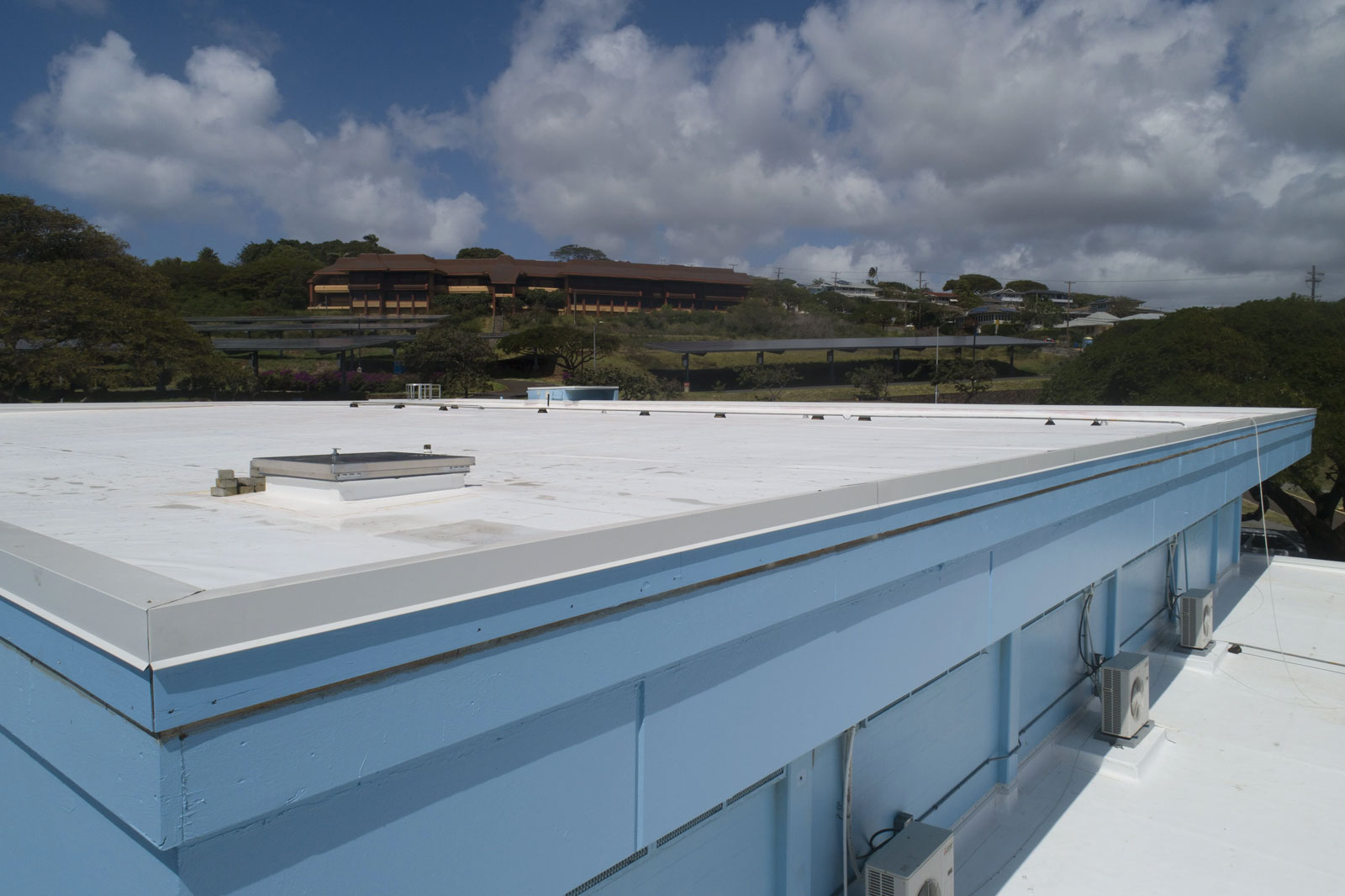
PVC membrane for Tucson commercial buildings with chemical exposure requirements — restaurant kitchen exhaust, food processing, dry-cleaning tenants — and for building owners pursuing the 25-year manufacturer warranty paths that Sika Sarnafil and Versico offer on qualifying 60-mil PVC installations.
Animal fat and cooking oil vapors from restaurant kitchen exhaust degrade standard TPO and EPDM membranes on contact. The chemistry is straightforward: grease particulate carried in exhaust air lands on the membrane surface, and under Tucson's 175-degree rooftop temperatures, it penetrates polymer chains and accelerates plasticizer loss. A TPO membrane that performs for 25 years on a midtown office building may reach critical seam-degradation threshold in 10 to 12 years on a high-volume restaurant kitchen exhaust exposure. PVC is chemically resistant to animal fats, vegetable oils, and the industrial solvents that restaurant and food-processing operators use in rooftop grease-trap maintenance. This is not a preference — it is a performance specification based on documented membrane failure patterns.
Tucson's restaurant density along 4th Avenue, Congress Street, the East Broadway corridor, and the University of Arizona perimeter commercial strip creates consistent demand for PVC roofing work. We see the failure pattern regularly: an aging TPO or EPDM roof on a restaurant building shows surface chalking and granular texture loss within three to five years, followed by membrane brittleness and seam check-cracking by year eight or ten. We document the chemical exposure signature when we core-pull on these buildings and specify PVC for the replacement.
PVC is also the membrane path to the longest standard manufacturer warranty available for commercial flat roofing in Tucson: Sika Sarnafil and Versico both offer 25-year NDL warranty programs on qualifying 60-mil PVC installations. For building owners making a long-term capital decision on a non-chemical-exposure building, the 25-year warranty term on PVC versus the 20-year maximum on TPO and EPDM is a meaningful factor in the lifecycle cost comparison.
PVC Membrane Specifications — 50-mil vs. 60-mil in Tucson
50-mil PVC: Entry commercial specification, carrying 15-year or 20-year NDL warranties. Not our default specification for restaurant, food-processing, or chemical-exposure Tucson buildings. The cost differential between 50-mil and 60-mil on a 15,000 to 30,000 square foot restaurant roof is modest relative to the performance difference in chemical-exposure and rooftop-traffic conditions.
60-mil PVC: Standard specification for chemical-exposure and long-warranty Tucson applications. Carries 20-year NDL warranties from most manufacturers and qualifies for the 25-year NDL programs from Sika Sarnafil and Versico on compliant system configurations. Substantially more puncture-resistant than 50-mil — relevant for Tucson restaurant buildings where rooftop grease-trap maintenance and HVAC refrigerant service create foot traffic that challenges thinner membranes.
PVC in Tucson Restaurant and Food-Service Environments
Tucson's restaurant concentration along 4th Avenue, the University of Arizona perimeter, and the Congress Street entertainment district creates a meaningful commercial roofing segment where PVC is the correct specification and other membranes will underperform. The failure trajectory we observe on restaurant TPO roofs that were not specified for chemical exposure: surface chalking and texture degradation visible within four to six years in the exhaust plume zone, followed by membrane stiffening and seam cracking in the highest-heat exhaust zone by years eight to eleven. The total lifecycle cost of two TPO cycles on a restaurant building substantially exceeds one 25-year PVC cycle.
We perform a surface-chemistry assessment on any roof where chemical exposure is suspected before specifying the replacement membrane. On any Tucson building that currently houses a restaurant, food processor, or dry-cleaning operation, PVC is the default specification — we do not work ourselves into a lower-cost membrane on a grease-exhaust exposure to save material cost on the initial scope.
Tucson's summer heat affects PVC installation scheduling: PVC heat-welding requires membrane surface temperatures below 130 to 140 degrees for consistent seam quality. We schedule welding operations in the early morning window and stage material in shaded staging areas to keep membrane rolls below the temperature threshold before installation. Afternoon installation is not performed during the June through September high-heat window.
Chemical Exposure Applications in the Tucson Market
University of Arizona and UA Tech Park: Research laboratory buildings with solvent exhaust, reagent-hood discharge, and specialty chemical handling create chemical exposure profiles that are worth confirming against PVC's resistance specifications before the system is selected. We ask about the specific chemical inventory at UA Tech Park tenant buildings before specifying the membrane — PVC covers a broad range of industrial solvents and organic chemicals but the specific resistance profile should be verified.
Davis-Monthan AFB adjacent industrial: Defense and logistics operations in the Irvington Road and Alvernon Way corridors adjacent to DMAFB include maintenance operations, fuel-handling facilities, and parts-washing operations with chemical exposure profiles that are worth assessing for membrane specification purposes. Perchloroethylene-exposed buildings — dry-cleaning operations are present in Tucson strip-center inventory — require PVC or a PVC-compatible coating over any EPDM membrane before the solvent-exhaust tenant takes occupancy.
Healthcare and biomedical — Tucson medical campuses: Biomedical research facilities at Banner University Medical Center Tucson and UA Health Sciences use solvent and reagent exhaust profiles that can degrade standard membrane formulations. PVC's chemical resistance makes it a conservative specification for facilities where the exhaust chemistry is complex or varies by research tenant.
Frequently asked questions
Is PVC more expensive than TPO on a Tucson commercial building?
Per square foot, PVC material cost runs 10 to 20 percent above comparable-thickness TPO. On a 20,000 square foot Tucson restaurant building, the material cost differential is roughly $3,000 to $6,000. On a building where a 25-year PVC warranty replaces a 10-to-12-year effective TPO service life under chemical exposure, the lifecycle cost of PVC is substantially lower. We present the lifecycle cost comparison in our scope documents — not just the initial installed-cost difference.
Can PVC be installed on an occupied Tucson restaurant during business hours?
PVC installation uses hot-air welding — no open flame, no torching. The primary coordination on occupied restaurant installations is scheduling around service hours. In Tucson's summer heat, we work the early morning window regardless of restaurant hours — which typically aligns with the pre-opening kitchen prep window anyway. We coordinate with the restaurant's kitchen manager on exhaust system shutdown windows during direct-overhead membrane installation and on the schedule for any penetration or boot work that requires rooftop exhaust stack access.
What does the 25-year Sika Sarnafil warranty cover on a Tucson PVC installation?
The 25-year NDL (no-dollar-limit) warranty covers material and labor costs to repair or replace warranted system components that fail due to manufacturing defect or installation defect within 25 years of the warranty date. It does not cover damage from building modifications, unauthorized penetrations made after installation, or failure to maintain the roof per the warranty's documented inspection requirements. In Tucson, the Sika Sarnafil 25-year program requires semi-annual documented inspection — we maintain Sika Sarnafil applicator credentials and include the maintenance program in our PVC closeout packages.
PVC scope for a Tucson restaurant or chemical-exposure building?
We will assess your building's chemical exposure profile, document existing membrane condition, and produce a PVC scope with the manufacturer warranty path that fits your capital horizon and Tucson climate requirements.
Ready to talk through a roof?
Tell us about the building and the roof problem. We'll document it and put a plan in writing — with an honest repair-vs-replace recommendation and no upsell pressure.
Documented, repair-first commercial & industrial roofing across Tucson and Pima County. Flat and low-slope systems for occupied buildings, planned around your operation.
Services
© 2026 Commercial Roofing Contractors Tucson. All Rights Reserved. Privacy Policy · Terms of Use