
Manufacturing Facility Roofing in Tucson, AZ
Commercial roofing for manufacturing plants, assembly facilities, and industrial buildings throughout Tucson, AZ.
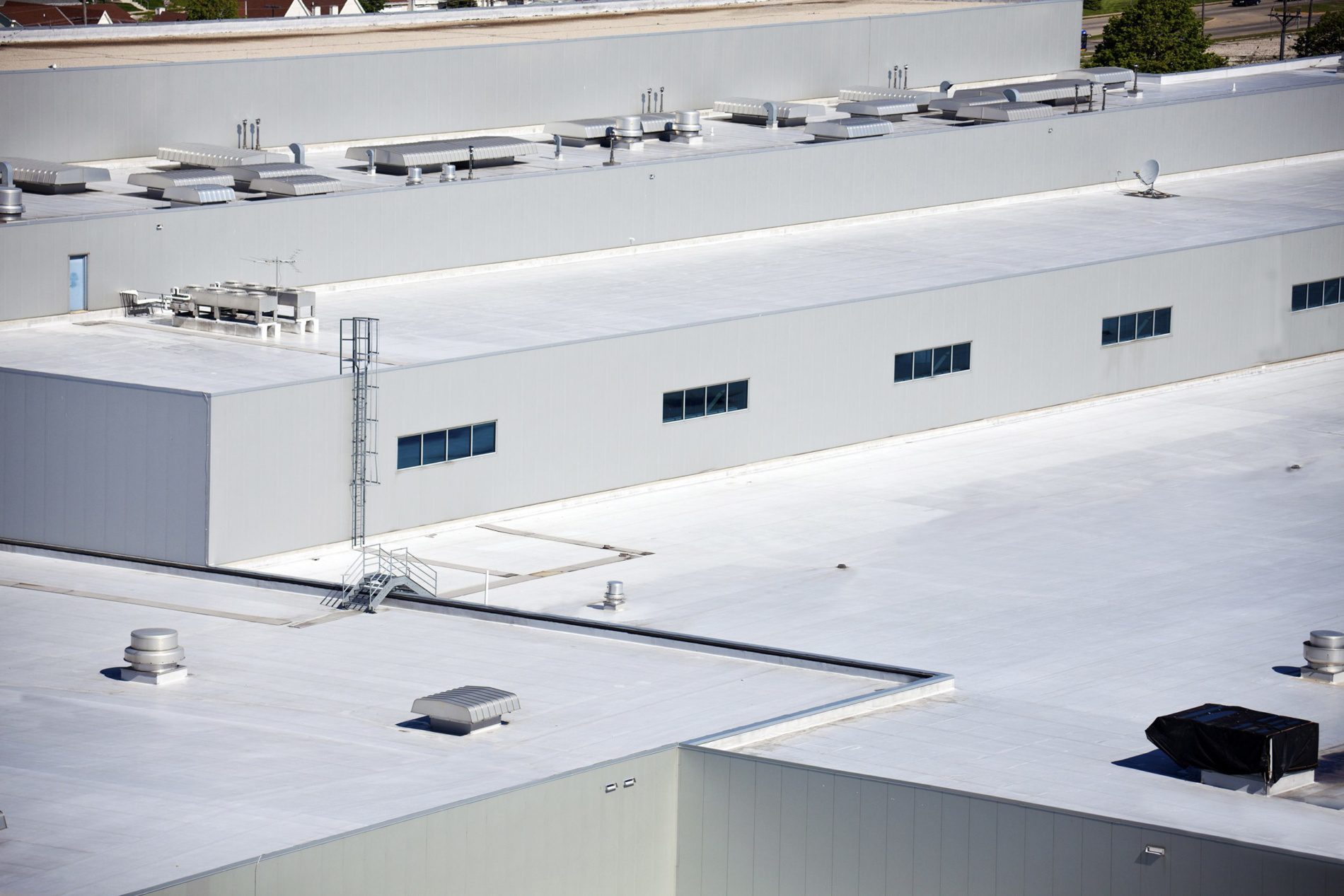
Raytheon Missiles and Defense, headquartered in Tucson with a massive manufacturing and testing campus on the city's south side, represents the defining example of defense manufacturing roofing demands in the Sonoran Desert. The Raytheon Tucson campus, where precision guided munitions and missile defense systems are assembled and tested, operates under a combination of security requirements, precision manufacturing environments, and desert climate conditions that create roofing challenges fundamentally different from any other industrial category in southern Arizona.
The Sonoran Desert climate is the single most important variable in Tucson defense manufacturing roofing. Surface temperatures on dark membrane roofs in Tucson can exceed 190°F in July and August, producing extreme thermal cycling between daytime highs and nighttime lows that can span 60°F or more. Standard 45-mil TPO that performs well in moderate climates can experience premature seam stress failures in Tucson if it is not formulated for high-temperature performance. Contractors experienced in Tucson industrial roofing specify 60-mil or heavier membranes with high-temperature-rated field and lap seam adhesives, and conduct heat-welded seam pull tests during installation to verify that seam strength meets specification under the extreme temperature conditions that will be encountered on this roof.
UV radiation in Tucson is among the most intense in the continental United States, with over 350 days of sunshine annually and a solar angle that delivers maximum UV intensity to horizontal surfaces from late spring through early fall. This UV environment attacks every polymer-based roofing material: membrane surfaces bleach and oxidize, adhesive chemistry degrades at laps, and sealant around penetrations becomes brittle. Manufacturers who offer UV-resistant membrane formulations developed specifically for high-UV desert applications—including titanium dioxide stabilizers and enhanced polymer crosslinking—are the appropriate partners for Tucson defense manufacturing facilities. Standard warranties may contain desert-specific exclusions that must be reviewed and, where possible, negotiated out before contract execution.
Process chemical exposure in Raytheon's Tucson complex includes propellant compounds, oxidizer residues, and specialized coating and adhesive systems used in precision munitions assembly. These chemicals are present in areas of the facility that are heavily access-controlled, but the vapor environment at the roofline above assembly areas can contain compounds that are not typically encountered in commercial or light industrial roofing. Contractors with appropriate security clearances and prior experience in Tucson defense manufacturing are the only viable option for certain areas of the campus, and the security coordination process should begin at least 90 days before planned work to allow for access verification.
Skylights in Tucson defense manufacturing facilities serve a different function than in northern industrial markets—here, they are managed to exclude rather than admit direct solar radiation during summer months when interior cooling loads are already extreme. Many skylights are fitted with light-diffusing or heat-rejecting films that must be preserved during roofing work. Contractors must protect these films from adhesive and sealant contact and must avoid creating ponding zones around skylight curbs that would keep moisture against the film and cause edge delamination. A pre-construction inventory of all skylight types and their film condition is a standard documentation step for Tucson industrial projects.
Schedule coordination at Tucson defense manufacturing facilities must account for both production schedules and the extreme summer heat that makes roofing work in July and August genuinely dangerous. OSHA's heat illness prevention standards are not theoretical in Tucson—workers exposed to direct sun on a rooftop membrane surface that may be 190°F require mandatory rest breaks, hydration protocols, and heat illness monitoring that significantly affect productivity. Many Tucson contractors restructure summer schedules to begin work at 4:00 AM and conclude membrane operations by noon, avoiding the peak heat hours while maintaining progress. This schedule shift requires corresponding adjustments to facility access protocols and security staffing.
Vibration from precision machining operations and large environmental test equipment in Tucson defense manufacturing creates the familiar deck-connection fatigue issues seen in the aerospace manufacturing sector generally. The additional complication in Tucson is that the same extreme thermal cycling that stresses membrane seams also works fasteners in steel decking—the differential thermal expansion between the fastener and the deck section creates micro-movement that, over decades, can produce loose fasteners even in buildings without significant equipment vibration. Uplift resistance testing of the existing deck-to-fastener connection should be conducted before any re-roofing project to verify that the existing deck can carry the required uplift loads for the new assembly.
Tucson's monsoon season, running from mid-June through mid-September, delivers brief but extremely intense rain events that test drainage systems in a manner unlike anything in the rest of the year. A roof that handles Tucson's typical 0.1-inch daily rainfall through normal infiltration and drainage can be overwhelmed by a single monsoon event delivering 2-3 inches in 30 minutes. Primary drains sized for average conditions must be supplemented with overflow provisions that handle the 100-year monsoon intensity without allowing ponding above the structural live load capacity of the deck. Tucson contractors experienced in this climate understand that monsoon-season storm intensity is the governing drainage design condition, not annual average rainfall.
Preventive maintenance on Tucson defense manufacturing roofs is structured around the monsoon season and the thermal transition periods in spring and fall. Pre-monsoon inspections in late May or early June verify that all drain sumps are clear, all lap seams are adhered, and all penetration flashings are intact before the storm season begins. Post-monsoon inspections in October confirm that any storm-related damage is identified and repaired before the cooler months. The combination of UV degradation, extreme thermal cycling, and periodic intense rainfall creates a failure rate for deferred maintenance items—particularly cracked sealant and partially-lifted lap edges—that is higher in Tucson than in most other US markets.
- How do Tucson's extreme summer temperatures affect roofing work schedules at defense manufacturing facilities?
- Membrane surface temperatures exceeding 150-190°F during summer afternoons require mandatory OSHA heat illness prevention protocols including mandatory rest breaks in the shade, at least one pint of water per hour per worker, heat illness monitoring, and worker acclimatization programs for new employees. Most Tucson contractors working on industrial projects in June through September start work at 4:00 AM and complete membrane operations by noon to avoid peak heat exposure.
- What drainage provisions are required for Tucson manufacturing buildings to handle monsoon rainfall intensity?
- The Tucson 100-year, 1-hour rainfall intensity of approximately 3.0 inches governs drain sizing for primary drains, and overflow provisions must be capable of passing the full flow difference between this intensity and the maximum primary drain capacity. In practice, this means generously sized overflow scuppers—typically 4 inches wide by 2 inches high—at intervals not exceeding 50 feet around the perimeter, sized according to AISC or NRCA drainage calculation methods.
- Are there security clearance requirements for roofing work on the Raytheon Tucson campus?
- Yes, portions of the Raytheon campus require access controlled under DCSA protocols. The specific clearance level varies by area. Some exterior roofing work in non-controlled zones requires only a standard contractor background check and facility badge, while work above classified production areas may require Secret clearance or continuous cleared escort. The facility security officer defines requirements during pre-bid coordination.
- How does Tucson's UV intensity affect membrane warranty terms?
- Some membrane manufacturers exclude or limit warranty coverage in high-UV environments such as Tucson without additional rider provisions. Contractors should review warranty terms specifically for geographic exclusions and, where the standard warranty has Sonoran Desert limitations, negotiate an enhanced warranty rider with the manufacturer that explicitly covers the Tucson UV exposure environment. This is typically available at a modest additional material cost.
- What membrane thickness is recommended for Tucson defense manufacturing facilities?
- A minimum 60-mil TPO with high-temperature formulation, or 60-mil PVC with plasticizer-stable chemistry, is the recommended starting specification for Tucson defense manufacturing facilities. Some projects in high-UV, high-traffic, or high-chemical exposure zones specify 80-mil membranes for additional thickness reserve against abrasion, UV degradation, and chemical attack. The heavier specification adds approximately $0.30-0.50 per square foot to material costs but can add 5-8 years to the realistic service life in Tucson's climate.
Frequently asked questions
Can you coat a BUR roof instead of replacing it?
Sometimes — and in Tucson it is often the right call when the substrate qualifies. We pull moisture cores before making any recommendation. If the insulation is dry, the gravel contact is intact, and there is no active blistering, a silicone coating system with the appropriate BUR primer is frequently the most cost-effective path: typically one-third the cost of tear-off and replacement, with a 10-15 year warranty from the coating manufacturer. If the insulation is wet, coating is not the answer and we say so.
How does Tucson's climate affect BUR faster than other markets?
Sustained UV at Index 11-plus for roughly five months of the year oxidizes the surface bitumen at a faster rate than in northern or coastal markets. The monsoon season then stress-tests seams and flashings that have been UV-cycled all summer. The combination accelerates alligatoring, flashing degradation, and gravel contact breakdown faster than manufacturer service-life tables — which are typically calibrated to moderate-climate exposure — predict. Annual inspection and maintenance is not optional on Tucson BUR systems; it is what determines whether the system reaches the end of its useful life on a planned schedule or fails on a monsoon emergency.
Is new BUR installation an option for Tucson commercial buildings?
Rarely, and we do not recommend it as a first choice. New BUR installation in the Tucson market has been largely supplanted by TPO and silicone coating systems that provide better reflectivity performance in the IECC Climate Zone 2B compliance environment. We can spec and install new BUR where a building's situation specifically requires it — but for most Tucson commercial buildings, a reflective single-ply system or a silicone restoration coating is the more defensible recommendation.
Aging BUR on a Tucson commercial building?
We will walk the roof, pull core cuts, and produce a written assessment — replace vs. coat vs. recover — with system options, installed cost bands, and warranty paths. No obligation.
Ready to talk through a roof?
Tell us about the building and the roof problem. We'll document it and put a plan in writing — with an honest repair-vs-replace recommendation and no upsell pressure.
Documented, repair-first commercial & industrial roofing across Tucson and Pima County. Flat and low-slope systems for occupied buildings, planned around your operation.
Services
© 2026 Commercial Roofing Contractors Tucson. All Rights Reserved. Privacy Policy · Terms of Use