
Office Building Roofing in Tucson, AZ
Commercial roofing for Class A, B, and C office buildings, suburban office parks, and downtown towers throughout Tucson, AZ.
Raytheon Missiles and Defense's corporate campus on South Kolb Road, one of Tucson's largest private employers and occupants of some of the city's premier Class A office and research buildings, sets the standard for sophisticated commercial roofing practice in a occupied institutional setting. Tucson office buildings present a unique combination of roofing challenges: extreme UV exposure and heat that demand reflective, energy-efficient membranes; occupied buildings where work must proceed without disrupting sensitive operations; and a growing emphasis on LEED certification and green building performance that increasingly shapes material selection and project documentation requirements.
Occupied building protocols are the first and most important operational consideration for any Tucson office re-roofing project. Unlike warehouse or retail facilities where short-term closures may be logistically manageable, a Class A office building housing hundreds of employees cannot simply be vacated for several weeks while roofing work proceeds. Work must be phased in sections sized to ensure that any given area's rooftop activities do not generate noise, odors, or vibration that disrupts the floors below. Early morning start times — 6:00 AM in Tucson's summer to beat the afternoon heat and finish work before peak occupancy hours — require coordination with building management and security to ensure rooftop access without compromising building entry protocols.
LEED certification and green building performance targets are increasingly central to Tucson office re-roofing projects, both for existing buildings pursuing LEED EB (Existing Buildings) certification and for new construction targeting LEED NC points. Cool roofs with Solar Reflectance Index values meeting LEED credit thresholds, TPO or thermoplastic polyolefin membranes manufactured with recycled content or sustainable production processes, and polyiso insulation with minimal blowing agent global warming potential all contribute to LEED point totals that can make the difference between a Silver and Gold certification level. A roofing contractor familiar with LEED documentation requirements can provide the material submittals and installation records needed to support the certification application.
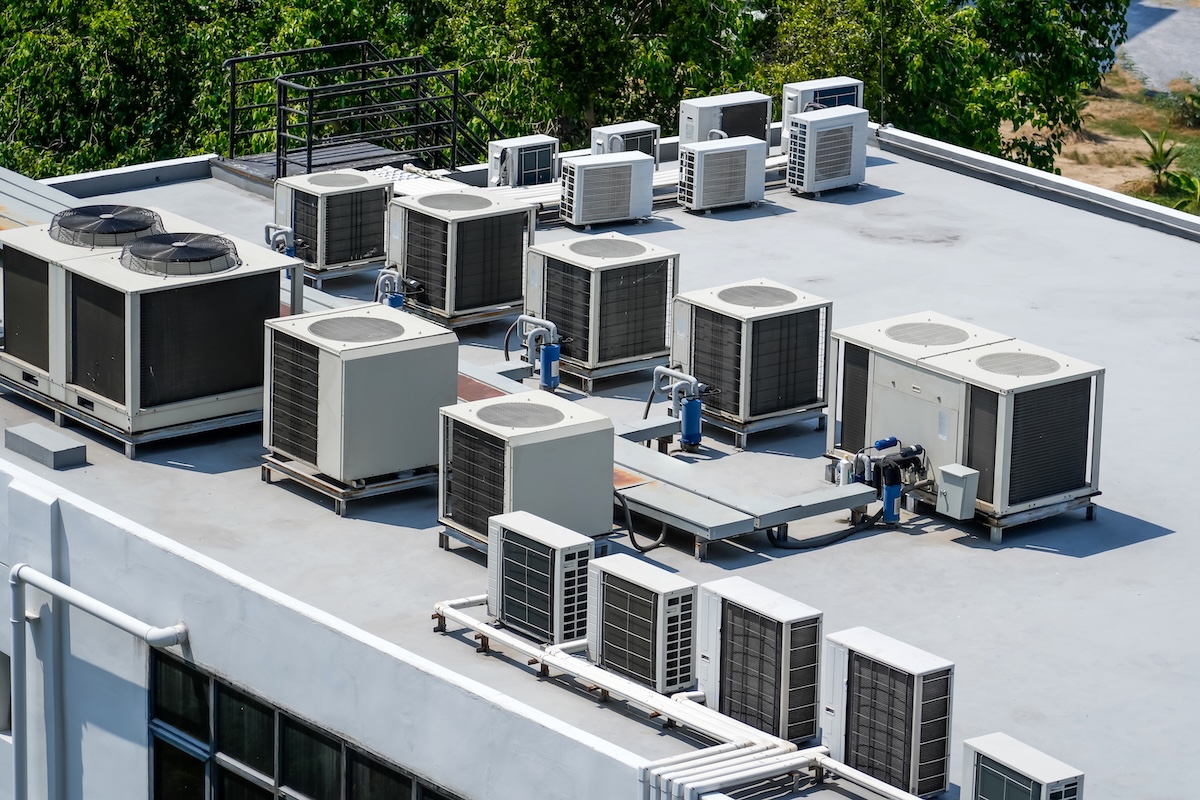
HVAC coordination is one of the most technically complex aspects of office building re-roofing in Tucson. Class A office buildings typically have dozens of rooftop HVAC units, exhaust fans, outside air intakes, and condenser units positioned across the roof deck at intervals that interrupt the membrane field with penetrations requiring individual flashing details. Before a roofing project begins, an HVAC contractor must assess whether any units require service or replacement — work that is far more cost-effective to perform before new membrane is installed than after. The roofing contractor must also work closely with the HVAC contractor to sequence any unit replacement with membrane installation to avoid damaging new roofing with equipment-handling activities.
Energy codes in Tucson require commercial office buildings to meet ASHRAE 90.1 continuous insulation provisions for Climate Zone 2B, and the Arizona Department of Fire, Building and Life Safety enforces these requirements at permit. Most Class A office buildings constructed before 2010 fall short of current code minimums and will be required to add insulation when re-roofing permits are pulled. The good news for Tucson office building owners is that the payback on cool-roof insulation upgrades in this solar-intense climate is among the fastest in the nation — a typical Tucson office building can reduce cooling energy consumption by 15 to 25 percent with a properly specified reflective membrane and insulation upgrade, generating measurable reductions in Tucson Electric Power bills within the first full cooling season.
Lease obligations are a significant financial consideration in office re-roofing projects for multi-tenant Class A buildings in Tucson. Office leases typically hold the landlord responsible for the building envelope, including the roof, while tenants are responsible for interior maintenance. However, if a roofing project's disruption — noise, odors from adhesives or solvents, temporarily blocked access to rooftop equipment serving tenant spaces — constitutes a nuisance under the terms of the lease, tenants may have grounds to seek rent abatement or damages. Legal review of the lease language before project commencement and early, clear communication with tenants about project phasing, expected disruptions, and mitigation measures reduces the risk of lease disputes that can turn a routine re-roofing project into a costly legal matter.
Green roof and cool-roof surface options available for Tucson office buildings include white membrane systems (highest reflectivity, most common), vegetated green roof systems (thermal mass, stormwater retention, but heavy and require irrigation in the desert climate), and metal roof panels with thermal breaks (architectural character, good longevity, but higher cost and requiring detailed flashing design). For most Tucson Class A office buildings, a white TPO or PVC single-ply membrane provides the best combination of reflectivity, durability, LEED contribution, and cost-effectiveness, particularly when combined with tapered polyiso insulation that improves both drainage and thermal performance simultaneously.
The fiscal and operational case for preventive maintenance programs on Tucson office building roofs is compelling. Tucson's UV intensity and thermal cycling means that minor defects — open seam laps, cracked sealant at penetrations, failing termination bar adhesive — progress to active leaks faster here than in milder climates. A twice-annual inspection program combined with budget allocation for prompt repair of identified deficiencies extends membrane service life and avoids the much higher costs of emergency leak response, interior damage remediation, and tenant disruption claims. Building managers who view roofing maintenance as a cost center underinvest relative to the actual risk exposure; those who view it as a capital asset management function allocate appropriately.
Tucson's commercial roofing permit process through the Pima County Development Services or City of Tucson Development Services Department requires a submittal package that includes project specifications, energy compliance documentation, and for large projects, structural engineer confirmation of load capacity. The permit review process for office buildings is more involved than for simple industrial projects because of the energy code compliance documentation required for HVAC-integrated roofing systems. Contractors who have navigated the local permit review process previously can anticipate and address typical reviewer questions before they trigger correction cycles, maintaining project schedule.
- How do you re-roof an occupied Tucson office building without disrupting tenants?
- Successful occupied re-roofing requires detailed pre-project communication with all tenants, phased work plans that limit active roofing to sections away from noise-sensitive areas, early morning start times to minimize disruption during peak business hours, and low-odor adhesive and sealant products to prevent air quality complaints. A pre-construction meeting with building management, major tenants, and the roofing contractor to review the project plan and establish communication protocols is an essential first step.
- What LEED credits can be earned through office re-roofing in Tucson?
- Cool-roof membrane installation contributes to the LEED Sustainable Sites Heat Island Reduction credit. Insulation products with low global warming potential blowing agents contribute to LEED Materials and Resources credits. Energy consumption reductions from cool membranes and insulation upgrades contribute to the LEED Energy and Atmosphere Optimize Energy Performance credit. The specific point value depends on the degree of performance improvement relative to the ASHRAE 90.1 baseline.
- What is the typical lifespan of a TPO roof on a Tucson office building?
- Well-maintained TPO systems on Tucson office buildings typically achieve 20–25 years of service life, though the intense UV environment means annual inspections and prompt minor repairs are more important here than in milder climates. Manufacturer-backed NDL warranties of 20 years are available for qualifying installations performed by factory-authorized contractors using manufacturer-supplied accessories.
- Do office building re-roofing projects in Tucson require tenant notification?
- Lease agreements typically require the landlord to provide reasonable advance notice of building maintenance activities that may cause disruption, and most commercial leases require written notice 30 to 60 days in advance for significant work. Arizona landlord-tenant law does not specify roofing project notice periods for commercial tenants, so the specific requirement will be found in each lease agreement. Review all tenant leases with legal counsel before project commencement.
- Can Tucson office buildings qualify for energy rebates on cool-roof installation?
- Yes. Tucson Electric Power's Commercial Solutions program offers incentives for cool-roof installations on commercial buildings that meet ENERGY STAR reflectance and emittance requirements. The rebate amount is calculated based on roof area and the improvement in solar reflectance compared to the existing system. Applications must be submitted before project commencement for most TEP commercial programs, so early coordination with the utility is essential.
Frequently asked questions
Can you coat a BUR roof instead of replacing it?
Sometimes — and in Tucson it is often the right call when the substrate qualifies. We pull moisture cores before making any recommendation. If the insulation is dry, the gravel contact is intact, and there is no active blistering, a silicone coating system with the appropriate BUR primer is frequently the most cost-effective path: typically one-third the cost of tear-off and replacement, with a 10-15 year warranty from the coating manufacturer. If the insulation is wet, coating is not the answer and we say so.
How does Tucson's climate affect BUR faster than other markets?
Sustained UV at Index 11-plus for roughly five months of the year oxidizes the surface bitumen at a faster rate than in northern or coastal markets. The monsoon season then stress-tests seams and flashings that have been UV-cycled all summer. The combination accelerates alligatoring, flashing degradation, and gravel contact breakdown faster than manufacturer service-life tables — which are typically calibrated to moderate-climate exposure — predict. Annual inspection and maintenance is not optional on Tucson BUR systems; it is what determines whether the system reaches the end of its useful life on a planned schedule or fails on a monsoon emergency.
Is new BUR installation an option for Tucson commercial buildings?
Rarely, and we do not recommend it as a first choice. New BUR installation in the Tucson market has been largely supplanted by TPO and silicone coating systems that provide better reflectivity performance in the IECC Climate Zone 2B compliance environment. We can spec and install new BUR where a building's situation specifically requires it — but for most Tucson commercial buildings, a reflective single-ply system or a silicone restoration coating is the more defensible recommendation.
Aging BUR on a Tucson commercial building?
We will walk the roof, pull core cuts, and produce a written assessment — replace vs. coat vs. recover — with system options, installed cost bands, and warranty paths. No obligation.
Ready to talk through a roof?
Tell us about the building and the roof problem. We'll document it and put a plan in writing — with an honest repair-vs-replace recommendation and no upsell pressure.
Documented, repair-first commercial & industrial roofing across Tucson and Pima County. Flat and low-slope systems for occupied buildings, planned around your operation.
Services
© 2026 Commercial Roofing Contractors Tucson. All Rights Reserved. Privacy Policy · Terms of Use