Infrared Roof Scanning in Tucson
Infrared thermography for commercial roof moisture detection in Tucson — optimal scanning windows in the Sonoran Desert, how we combine IR with core sampling, and when cool morning scans outperform evening surveys in the Tucson climate.
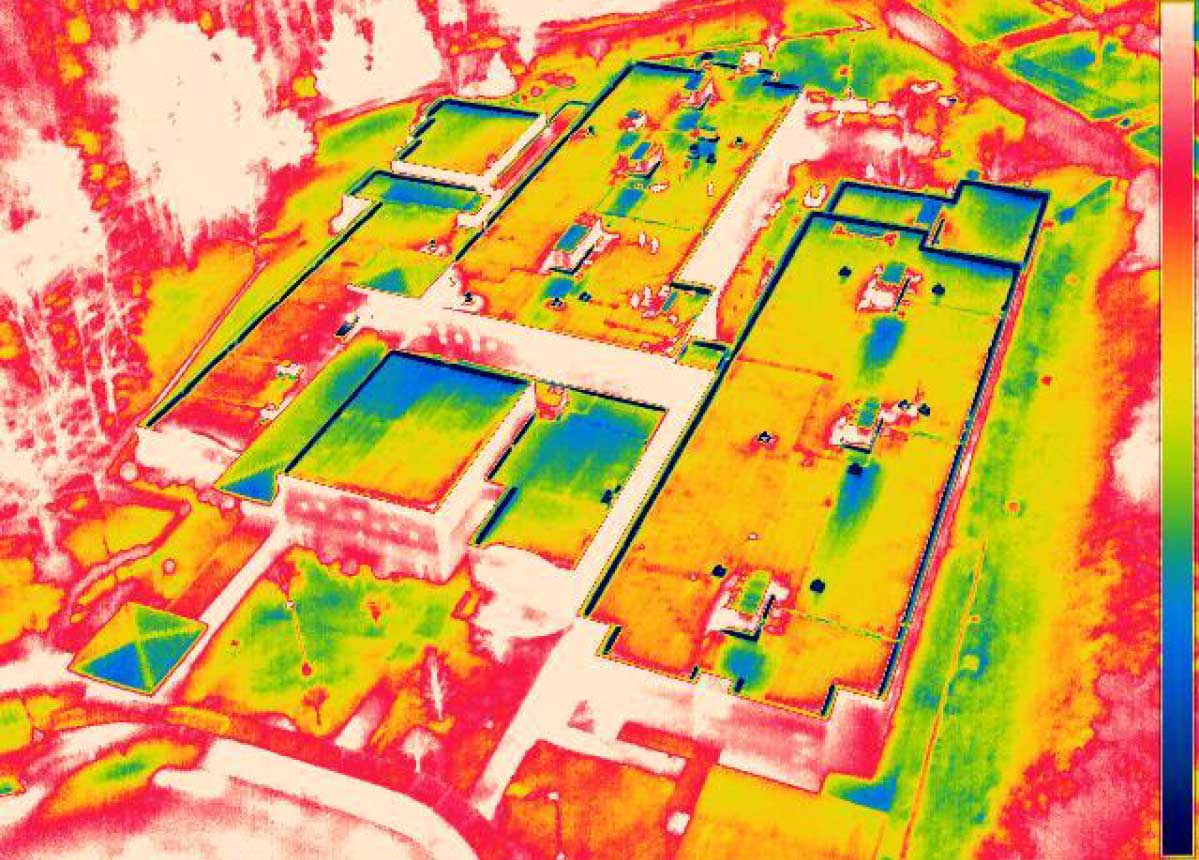
Infrared thermography can map probable moisture zones across a 100,000 square foot Tucson commercial roof in a single scanning window — a capability that core sampling alone cannot match at that scale. The Sonoran Desert's thermal dynamics create specific IR windows that differ from moderate-climate roofing practice. We schedule scans when the physics work, not when it is convenient.
Infrared scanning for commercial roofing works on a principle that is particularly relevant in Tucson: wet insulation retains heat longer than dry insulation after solar loading ends. A thermal camera scanning the roof surface detects the moisture zones as warmer anomalies against the cooling dry field. In a climate with Tucson's solar intensity — UV Index 11-plus for roughly five months of the year, rooftop surface temperatures above 175°F on absorptive membranes — the solar charge available to drive that thermal differential is substantial. The challenge in Tucson is not insufficient solar loading; it is managing the timing of the scan relative to how fast the roof cools.
Tucson's evening cooling curve differs from moderate-climate markets in ways that affect IR scan scheduling. Summer nights cool slowly because the ambient temperature remains above 80°F well past midnight, and the thermal differential between wet and dry insulation zones is suppressed when the roof surface temperature stays high relative to ambient. The months when IR produces the clearest thermograms in Tucson are October through April — the post-monsoon and winter period when daytime solar loading is sufficient to charge the insulation, evening temperatures drop quickly, and the ambient-to-surface differential creates a clear signal.
The pre-monsoon window in May introduces a practical constraint: May is one of the best Tucson months for clear thermograms — warm days, fast evening cool-down — but the pre-monsoon inspection window is when the building needs its maintenance work completed, not just its moisture documented. We schedule May IR scans as part of the pre-monsoon inspection rather than as standalone events, so that the IR findings can be integrated into the repair prioritization for the work that needs to happen before June.
When IR Works and When It Does Not in Tucson
Conditions that produce clear, usable Tucson thermograms: At least 4 hours of direct solar loading on the roof surface, a surface-to-ambient temperature differential of 15 to 20°F or more at scan time, wind below 15 mph, no precipitation in the prior 48 hours, and a cool-down curve steep enough to create contrast between wet and dry zones within the scan window. October through April — and particularly November through February — consistently produces these conditions in the Tucson climate.
Cool morning scans are an alternative in Tucson that moderate-climate markets rarely use. When the roof has cooled overnight and pre-dawn ambient temperatures are low, wet insulation that retained heat through the night remains detectably warmer than the dry field at first light. This pre-dawn window — roughly 5:00 to 7:00 AM — can produce usable thermograms during periods when evening scans are ambiguous due to slow cool-down. We use morning scans on reflective-membrane buildings, which absorb less solar energy and produce a weaker evening signal, and on buildings where scheduling constraints make evening access difficult.
Conditions that produce ambiguous Tucson thermograms: July and August evenings when ambient temperatures remain above 85°F at scan time, overcast days that reduce solar loading, white or light-gray TPO and PVC membranes that absorb less solar energy and generate a weaker signal, and buildings with unusually high thermal mass in the deck assembly that changes the cool-down curve. Highly reflective membranes — common in the Tucson market because Arizona's energy code incentivizes them — require either longer post-solar observation time or the morning-scan protocol to produce reliable results.
How We Use IR With Core Sampling in Tucson
The IR scan produces a thermogram with warm anomaly zones marked as probable moisture locations. We then pull cores at each significant anomaly zone to confirm the finding and at several presumed-dry zones to validate the scan's accuracy on that specific building. The combined approach — IR to map probable zones, cores to confirm — lets us cover large Tucson roofs with higher confidence than either tool alone.
For Tucson commercial roofs in the 75,000 to 200,000 square foot range — common in the industrial and institutional building stock around Raytheon facilities, Banner Health campuses, and DMAFB contractor operations on the southeast side — IR plus targeted cores typically produces equivalent confidence to a dense grid-pattern core survey at lower cost. A full grid-pattern core survey on a 150,000 square foot building requires 40 to 50 cores. IR-guided targeted core sampling on the same building, with confirmed anomaly zones plus dry-zone verification cores, typically achieves comparable confidence at 18 to 25 cores.
The combined deliverable codes each zone as confirmed-wet (core-verified), probable-wet (IR anomaly without core confirmation), or dry (both IR and core clear). This three-level classification tells the building owner where the confidence is high and where it is inferred — so the coating or replacement decision is based on the data's actual certainty rather than a uniform confidence claim across the full roof area.
Equipment, Scheduling, and Report Format
We use FLIR commercial-grade radiometric thermal cameras calibrated for roofing applications. Every anomaly in the thermogram is paired with a visible-light photograph of the same zone, so the document shows both the thermal signature and the membrane surface condition at each flagged location. Radiometric resolution captures the full temperature gradient across the roof, not just relative hot-and-cold contrast — which matters when evaluating partial saturation in the insulation layers below a reflective membrane.
Scheduling in Tucson is tied to the weather rather than a fixed calendar. We monitor ambient temperature forecasts and surface cool-down projections for each scan window and will reschedule rather than scan under conditions that would produce ambiguous results. A thermogram from a marginal scan night is not useful data — it introduces probable-wet designations at zones that may be dry and misses wet zones that a good scan would have detected. We notify the building owner before the scan window if conditions are not favorable and propose an alternative date.
The IR report is formatted as an addendum to the condition report. The thermogram mosaic of the full roof, the annotated anomaly map with zone-keyed designations, and the core-confirmation results integrate into the full condition record rather than sitting as a standalone document. This integration is what makes the IR findings usable in capital planning and warranty coordination — the moisture data is part of the same zone-referenced record as the visual condition assessment.
Frequently asked questions
What is the best time of year for IR scanning in Tucson?
October through April is the reliable window for evening scans. November through February typically produces the strongest thermal differentials because daytime solar loading is substantial and evening temperatures drop quickly — the conditions that create the clearest contrast between wet and dry insulation zones. May works well but competes with the pre-monsoon inspection window. June through September is generally not recommended for evening scans; morning scans are the alternative during that period for urgent situations.
Can you do IR scanning in the morning instead of the evening?
Yes. Pre-dawn morning scans — roughly 5:00 to 7:00 AM — are a viable alternative in Tucson when evening cool-down is slow or when the building has a highly reflective membrane that produces a weaker evening signal. Wet insulation that retained heat overnight remains detectably warmer than the dry field at first light. We use morning scans on white TPO and PVC buildings where the IR signal is attenuated and on buildings where scheduling constraints make evening access difficult.
Does Tucson's reflective membrane requirement affect IR scanning?
Yes. Arizona's energy code incentivizes white and light-gray membranes for Climate Zone 2 compliance, which means a large share of the Tucson commercial roof inventory has high solar reflectance. Reflective membranes absorb less solar energy during the day, which reduces the thermal charge available to create the wet-versus-dry differential at scan time. On highly reflective buildings, we either extend the observation time after solar peak, use the morning scan protocol, or rely more heavily on targeted core sampling than on IR anomaly mapping.
Is infrared scanning required, or can we just do core sampling?
Core sampling without IR is appropriate for most Tucson buildings under 50,000 square feet or where prior inspection has identified the probable moisture zones from ceiling staining or targeted membrane probe-test failures. IR adds the most value on large Tucson buildings — industrial and institutional buildings above 75,000 square feet — where a full grid-pattern core survey would be expensive and the IR season conditions are favorable. We do not recommend IR as a default on every building regardless of conditions.
Schedule an IR moisture survey for your Tucson commercial roof.
We assess whether IR conditions are favorable for your building and schedule the scan for the right window — then combine the thermogram with core-confirmed findings to produce a moisture distribution map you can make capital decisions from. Call 520-523-6122 or use the form.
Ready to talk through a roof?
Tell us about the building and the roof problem. We'll document it and put a plan in writing — with an honest repair-vs-replace recommendation and no upsell pressure.
Documented, repair-first commercial & industrial roofing across Tucson and Pima County. Flat and low-slope systems for occupied buildings, planned around your operation.
Services
© 2026 Commercial Roofing Contractors Tucson. All Rights Reserved. Privacy Policy · Terms of Use