
Religious Building Roofing in Tucson
Commercial roof replacement and maintenance for Tucson churches and faith-community campuses — large Tucson church campuses, Foothills congregations, and UA-area faith communities — with weekend blackout scheduling and transparent capital documentation.
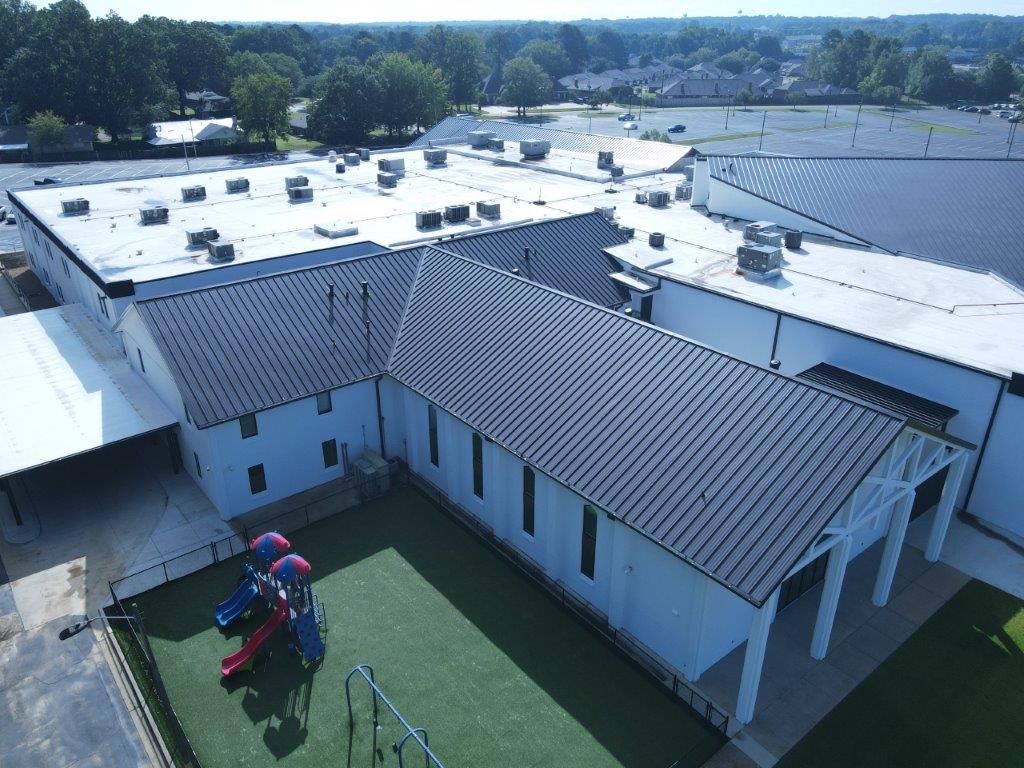
Tucson's faith community campuses range from large multi-building complexes in the Foothills and northwest corridors to historic congregational buildings near the University of Arizona and midtown parishes serving established neighborhoods. Roof replacement on these campuses requires weekend blackout scheduling, transparent scope and cost documentation suitable for congregational approval, and production planning that protects weddings, funerals, and major religious observances.
Religious buildings present a scheduling and communication dynamic that is unlike most commercial roofing environments. The facility is at peak occupancy on Saturdays and Sundays — the opposite of a standard commercial building — and major life events (weddings, funerals, baptisms) and religious observances (Easter, Christmas, High Holidays, Ramadan) create fixed blackout periods that must be identified before a production schedule is set. A roof crew showing up on a Saturday morning of a major service without prior coordination is not just disruptive — it is a relationship-ending event with the facility.
Tucson's large church campuses — the sprawling multi-building Foothills congregations along Oracle Road and North Thornydale Road, the established Catholic parishes in midtown and south Tucson, the large evangelical campuses on the northwest and south sides, and the faith communities adjacent to the University of Arizona campus along Park Avenue and Euclid Avenue — have facility managers or property committees who oversee capital projects. The project approval process often requires presentation to a board, elder council, or property committee before scope and budget are authorized. We produce scope documentation in a format that supports lay-board review — plain-language scope description, itemized cost breakdown, and a written maintenance program that shows how the capital investment is protected after completion.
We have worked with Tucson faith communities across multiple denominations and building vintages. Historic masonry buildings near the UA campus — some over 100 years old with clay-tile or built-up roofing on structural-clay-tile decks — require building-specific assessment before any scope is written. Modern campus buildings in the Foothills and northwest corridors are typically on standard flat-roof construction but may have architectural metal elements, clerestory details, and complex parapet geometry that drives flashing work above what the deck area alone suggests.
Weekend Blackout Scheduling and Calendar Coordination
Most Tucson church campuses have Sunday services as their primary occupancy event, with Saturday events (weddings, bar/bat mitzvahs, Shabbat observances) adding a second peak. We schedule loud demolition work — tear-off, deck preparation — exclusively for Monday through Friday windows on all religious-building projects. Membrane installation and seaming work that can proceed quietly may be permitted on Saturdays at some facilities after facility-manager review, but this is confirmed in writing before production begins and never assumed.
Major religious calendar events generate extended blackout periods on church-campus roofing projects. Christmas and Easter at Christian facilities, High Holidays at synagogues, and Ramadan at mosques typically result in multi-week or multi-month periods when additional disruption to the campus is not acceptable to the congregation. We identify these blackout periods before the production schedule is set and build the project timeline around them — not around what would be most efficient for the roofing crew.
We provide the facility manager or property committee with a written production schedule at least three weeks before mobilization, along with a request for any event calendar that has fixed occupancy dates for the production window. Any event added to the calendar during production that requires a schedule adjustment is communicated to us at least five business days in advance, and we adjust accordingly.
Scope Documentation for Board and Congregational Approval
Religious building capital projects often require approval by a lay board, elder council, property committee, or congregational vote before a contractor can be engaged. These decision-making bodies are not roofing professionals — they are volunteers from the congregation who need to understand what is wrong with the current roof, what the proposed remedy is, how much it costs, and why it is the right capital decision for the faith community's resources.
We produce a condition report for Tucson faith communities that includes plain-language findings (what we found and why it matters), a scope description without trade jargon, an itemized cost breakdown, and a summary of the maintenance program that follows project completion. We are available to present the findings to a property committee or board in person if the facility requests it. We do not pressure religious facility clients toward particular decisions — our role is to give the decision-makers accurate, complete information so they can make the right capital call for their community.
For historic congregational buildings near the UA campus or in Tucson's established midtown neighborhoods, we include a structural-deck assessment in the condition report when the deck type or age creates uncertainty about fastening capacity for a new membrane system. Some of Tucson's older faith-community buildings have structural conditions that affect what roof systems are appropriate — ballasted systems, fully adhered membranes, or tapered insulation over existing systems — and the board needs that information to make an informed decision.
Historic and Architecturally Complex Religious Buildings
Tucson has a significant inventory of historic religious buildings — Catholic missions and parishes with clay-tile roofing, early 20th-century mainline Protestant sanctuaries with built-up roofing on structural-clay-tile decks, and adobe-construction chapels with parapet details that require handcraft flashing work. These buildings require individual assessment by a project manager experienced in historic building conditions, not a standard flat-roof scope applied across all building types.
Clay-tile roofing on Tucson mission-style structures is technically outside our primary scope of commercial flat-roof work, but the flat-roof sections that accompany these buildings — fellowship halls, education wings, administrative additions — are our primary focus. We assess the flat-roof sections in context with the overall building condition and coordinate with the facility on any clay-tile or sloped-roof elements that our scope does not cover but that affect the overall waterproofing condition of the building.
Architectural metal elements, stained-glass clerestory windows, and custom parapet details on Foothills and midtown church campuses require flashing detailing above standard practice. We document every non-standard flashing condition during the inspection walk and include the proposed detail in the project scope before contract execution. A Foothills church campus with a clerestory that sits at the parapet-to-membrane transition requires more flashing engineering than a standard commercial building, and the scope reflects that.
Frequently asked questions
How do you avoid disrupting Sunday services during a roof replacement?
Loud demolition work — tear-off, deck preparation, heavy equipment operations — is scheduled Monday through Friday only on all religious-building projects. Quiet work (seaming, coating application, flashing installation) may continue on Saturdays at facilities where the facility manager confirms it will not conflict with scheduled events. We provide a written production schedule three weeks before mobilization and request the full event calendar for the production window so we can identify any days that require production pauses.
Can you present the roof scope and condition report to our church's property committee?
Yes. We are available to present our condition findings and the proposed scope to a property committee, board of elders, or similar lay decision-making body at the facility's request. We bring the written report, the moisture-core data, and inspection photos to the presentation. We do not sell during these presentations — we answer questions and provide the information the committee needs to make an informed capital decision.
Do you work on historic Tucson church buildings near the University of Arizona?
Yes, for the flat-roof portions — fellowship halls, education wings, administrative additions, and any other flat-roof section attached to or associated with the historic sanctuary. We assess the structural deck condition on historic buildings before writing a scope and flag any conditions — clay-tile deck, low fastening capacity, historic finishes adjacent to the work area — that affect the appropriate system specification or require special protection measures.
How do you handle monsoon season on a faith-community campus where disruption must be minimal?
The same monsoon dry-in protocol applies regardless of building type: no section left open overnight July through September, daily tear-off sized to same-day dry-in capacity. For religious-building projects, we also avoid scheduling intensive tear-off work the week before a major holiday or high-attendance event, so that if an unexpected weather delay extends the work window, there is a buffer before the building is at peak occupancy.
Get a roof condition report for your Tucson faith community.
Our project managers will walk the campus, document every roof section, and produce a written condition report with plain-language findings and a scope written for lay-board review — with a presentation to your property committee available on request.
Ready to talk through a roof?
Tell us about the building and the roof problem. We'll document it and put a plan in writing — with an honest repair-vs-replace recommendation and no upsell pressure.
Documented, repair-first commercial & industrial roofing across Tucson and Pima County. Flat and low-slope systems for occupied buildings, planned around your operation.
Services
© 2026 Commercial Roofing Contractors Tucson. All Rights Reserved. Privacy Policy · Terms of Use