
Single-Ply Roofing in Tucson, AZ
Single-ply roofing for Tucson commercial buildings — TPO, PVC, and EPDM specified for Sonoran Desert UV, Arizona energy code reflectivity requirements, monsoon wind loads, and each building's actual substrate and use profile.
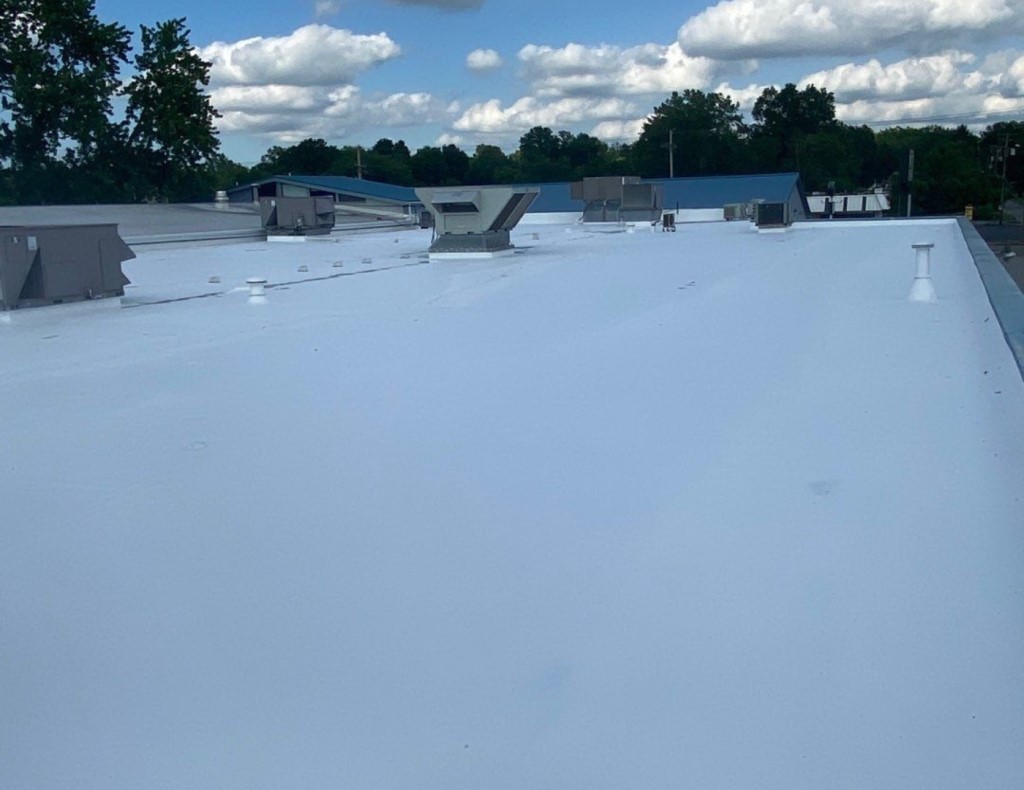
TPO, PVC, and EPDM single-ply membranes specified and installed for Tucson's operating conditions — UV Index 11-plus summer months, 175-degree rooftop surface temperatures, monsoon haboob wind loads, Arizona IECC reflectivity requirements, and each building's specific substrate, use, and chemical exposure profile.
Single-ply membranes — TPO, PVC, and EPDM — dominate Tucson commercial roofing for reasons that are specific to this market, not just general industry trends. White TPO and white PVC meet Arizona's IECC 2018 Solar Reflectance Index requirements for Climate Zone 2B without supplemental coating or white-granule specification. Reflective membranes reduce rooftop surface temperatures by 50 to 70 degrees Fahrenheit relative to dark surfaces — from 175 degrees to 105 to 125 degrees under a Tucson July afternoon sun. That temperature reduction extends membrane service life by reducing thermal cycling stress on seams and laps, and cuts HVAC cooling load on the building below. In Tucson's climate, the reflectivity case for white single-ply is not theoretical: it produces measurable performance differences that show up in both energy bills and inspection records.
The attachment method selection on a Tucson single-ply project is where the specification either matches or mismatches the building's actual conditions. Mechanically attached TPO is the volume installation method in this market — economical, fast, and appropriate for most Tucson commercial buildings with steel deck substrates in standard Exposure B wind terrain. Fully adhered systems cost more in labor but eliminate membrane flutter under wind load and are required when the deck cannot tolerate additional fastener penetrations or when wind-uplift design requirements exceed what mechanical attachment can deliver. Haboob events in Tucson's monsoon season produce 60-mph wall winds that test perimeter and corner fastener patterns on mechanically attached systems — we design attachment density to IBC 2021 Chapter 15 requirements, with perimeter and corner zone reinforcement that is non-negotiable.
We specify the attachment method and membrane type against each building's actual wind-uplift zone, deck type, chemical exposure profile, and use conditions — and we document the selection reasoning in the scope document so the building owner understands what was designed and why.
Attachment Method Selection for Tucson Commercial Buildings
Mechanically attached: Appropriate for the majority of Tucson commercial buildings with metal deck substrates in standard Exposure B wind terrain — midtown professional and medical-office buildings, the retail corridors along Oracle Road and Broadway, the industrial and logistics buildings on the southeast side along Irvington and Alvernon. Attachment pattern (screws and plates per linear foot at seam laps) is designed against the building's IBC 2021 wind-uplift zone and exposure category. Perimeter and corner zones require higher fastener density than the field — haboob events have peeled mechanically attached perimeter sections from Tucson commercial buildings where original patterns were specified at field-zone density throughout. We design to the zone, not a uniform pattern.
Fully adhered: Required when the deck cannot accept additional fastener penetrations (some structural concrete decks, existing waterproofed substrates, green-roof assemblies), when wind-uplift design requirements exceed what mechanical attachment can achieve for the building's exposure category, or when the building's operations make membrane flutter under wind load — noise, vibration, mechanical disturbance — operationally unacceptable. University of Arizona research facilities and Banner Health buildings have specified fully adhered systems specifically to avoid fastener penetration of existing waterproof deck assemblies. Adhesive selection in Tucson requires attention to elevated-temperature bond performance — adhesives must maintain bond integrity at substrate temperatures that can exceed 130 degrees during installation and 150 degrees during Tucson summer operation.
Ballasted: Loose-laid membrane held by washed aggregate ballast at 10 to 12 psf. Rarely specified on new Tucson commercial construction — structural verification for ballast load consumes available live-load capacity that Tucson building owners typically need for rooftop equipment, and the aggregate ballast accumulates caliche dust and Sonoran Desert debris that complicates drain maintenance. Found on older downtown Tucson buildings from the 1970s and 1980s. We assess ballasted-roof replacement scope the same as any other substrate — cores confirm insulation condition, and the replacement typically transitions to mechanically attached or fully adhered to eliminate the ballast.
Membrane Selection Within Single-Ply — Tucson Market Context
TPO (thermoplastic polyolefin): Default specification for most Tucson commercial buildings without chemical exposure requirements. White heat-weldable membrane with IECC 2018 reflectivity compliance in standard white. 20-year NDL warranty at 60-mil and 80-mil from major manufacturers. Most economical single-ply material cost per square foot. The dominant membrane in new Tucson commercial construction from 2005 through the present.
PVC (polyvinyl chloride): Specified for chemical exposure environments — restaurants, food-processing tenants, dry-cleaning operations, pharmaceutical and biomedical facilities at UA Health Sciences and Banner campuses. 25-year NDL warranty available from Sika Sarnafil and Versico on qualifying 60-mil installations. Material cost runs 10 to 20 percent above comparable TPO. Lifecycle cost advantage over TPO on chemical-exposure buildings is substantial over a 25-year horizon.
EPDM (ethylene propylene diene monomer): Thermoset membrane specified in Tucson for medical facility chemical-resistance requirements and for institutional building owners with established EPDM maintenance programs. Black EPDM absorbs rather than reflects heat — rooftop surface temperatures on standard EPDM in Tucson's July sun exceed 175 degrees. For buildings without a specific chemical-resistance or institutional requirement, white TPO or PVC is the more appropriate Sonoran Desert specification. 20-year NDL at 60-mil available from Carlisle, Firestone, and Johns Manville.
Tucson Climate Factors in Single-Ply System Design
UV degradation rate: Sonoran Desert UV Index exceeds 11 from approximately April through September. Membrane polymer degradation at this UV load runs faster than manufacturer service-life tables calibrated on moderate-climate testing data. Seam inspection intervals that are adequate in Phoenix or Albuquerque may be insufficient in Tucson without accounting for the sustained extreme UV load. Our inspection protocol for Tucson single-ply systems includes probe testing at the UV-highest-stress locations — parapet corners, penetration clusters, and perimeter laps — as the primary diagnostic step, not an afterthought.
Thermal cycling and seam stress: Tucson's 30-to-40-degree daily temperature swings in spring and fall, and 70-degree swings on clear winter nights following warm afternoons, stress single-ply seam bonds through thousands of cycles over a roof's service life. Fully adhered systems manage thermal movement through the substrate and require properly designed expansion joints at column lines and at 150-foot intervals on large projects to prevent stress cracking at parapet corners. Mechanically attached systems accommodate thermal movement through the membrane, but the cycling fatigue at fastener plates is accelerated under Tucson's swing range.
Monsoon wind and debris loads: Haboob events that accompany Tucson's monsoon season produce 60-mph wall winds with embedded debris loads — gravel, caliche chips, rock fragments — that impact membrane surfaces and perimeter edge metal. We specify perimeter edge metal attachment to FM Global wind-uplift tables for each building's exposure zone, and we inspect edge metal and perimeter flashings in the post-monsoon inspection specifically for haboob-driven dislodgement or debris puncture.
Frequently asked questions
How do you select the attachment method for my Tucson building?
We need the building location, deck type, and building height to run the wind-uplift calculation per IBC 2021 and assess the Exposure category for the building's terrain. We evaluate deck condition during the inspection walk and present the cost and performance comparison between mechanical attach and fully adhered in the written scope with the wind-uplift calculation shown. The selection reasoning is in the document — you see the engineering basis, not just the recommendation.
Can a single-ply system be installed over an existing Tucson roof without full tear-off?
Yes — recover installation over existing mod-bit, EPDM, or BUR is viable when moisture cores confirm dry insulation, when the existing system provides a dimensionally stable substrate for the new membrane, and when the roof has no more than one existing layer over the deck (Arizona building code limits roofs to two total layers before tear-off is required). Recovery avoids tear-off and disposal cost and is often the more economical option on Tucson buildings where the existing substrate is in serviceable condition.
What is the difference between a manufacturer NDL warranty and an FM Global rating on a Tucson building?
FM Global ratings — FM 1-60, FM 1-90, FM 1-120 — are third-party uplift resistance classifications used primarily by commercial property insurers to confirm the roof system can withstand rated uplift pressure. Manufacturer NDL warranties cover material and installation defects over time. Some Tucson commercial building owners, particularly those with FM Global property insurance policies on higher-value or defense-sector facilities, are contractually required to install FM-rated roof systems. We design to FM ratings on these projects and include the FM compliance documentation in the permit and closeout package.
Single-ply specification and installation on your Tucson commercial building.
We design the attachment method and membrane selection against your building's actual wind-uplift zone, substrate, chemical exposure profile, and Arizona energy code requirements — then install with manufacturer warranty closeout.
Ready to talk through a roof?
Tell us about the building and the roof problem. We'll document it and put a plan in writing — with an honest repair-vs-replace recommendation and no upsell pressure.
Documented, repair-first commercial & industrial roofing across Tucson and Pima County. Flat and low-slope systems for occupied buildings, planned around your operation.
Services
© 2026 Commercial Roofing Contractors Tucson. All Rights Reserved. Privacy Policy · Terms of Use